This brief was called ‘Build Your Own Brief’ where we were told to choose a topic we were interested in, explore it and creative a ‘What if…’ speculative response (through a product or service). Our outcome had to be a 1 minute case study video that included: the problem, the product/ service (with branding), show how it works and a final slogan.
Researching Iris-scanning and Data-breaching Technology
With the partnership of artificial intelligence softwares and data collection becoming apparent in our daily lives, some may say we are essentially being stripped of our privacy rights. These subtle and inconspicuous security breaches are quickly developing digital profiles of the general public without their consent or knowledge. The ‘Black Mirror’ predictions could rapidly become our reality if we don’t rethink our approach to how big companies and powerful figures in society are using our private information/ data.
There are companies across the world that now have AI emotion-recognition systems that track your reactions constantly gathering data about your every move understanding your instability and ‘capability’ as a worker. They understand this by checking how ‘happy’ you are, and any change of the expression means you’re in danger of losing your job or being punished.
References: An AI ‘Emotion-Recognition System’ Can Track How ‘Happy’ Chinese People Are at Work (insider.com)
This lead me to question ‘What if we could wipe our digital footprint?‘
Data Clearing Apps and AI Tracking Prevention
While researching different ways current researchers are targeting this issue, I came across an article which spoke about programmer Jaan Tallinns essay called ‘Staring into the Singularity’ where Tallinn writes about what the world would be like if AI surpassed human-level intelligence. In an article called ‘Can we stop AI outsmarting humanity?‘, where Tallinn explains how he is funding strategies to try and ‘box AI‘ either physically and containing it, or by programming it to be limited to it’s functionality. Other programmers are trying to teach AI to respect and ‘adhere to human values‘. One of Tallinn’s researchers, Co-founder of ‘Aligned AI’ Stuart Armstrong, has full time researcher position at Oxford University where he focuses on AI safety. He has written a paper alongside his company co-founder Nick Bostrom, where they looked into boxing AI by restricting the resource to a structure, creating boundaries through coding questions into its thought process. These limitations create a safe net for machines and AI systems to not breach the ‘current world order’ and increases humanities chance of survival against overriding machines.
Armstrong has also written a paper on a physical or digital switch ‘big red off button’ to turn off all AI activities in an event of a breakout. One of his and his team’s biggest challenge was struggling with the issue of AI duplication across the internet. Hackers and internet experts are able to do everything with the right tools and equipment, so this button strategy would have to be very well secured and controlled.
References – ‘Can we stop AI outsmarting humanity?‘
Film and TV Series References
There are many films and TV series that predict what our world will be like physically and socially in the future, however two that I remember the most clearly are Ready Player One and Black Mirror. Both of them contain an element of fear around the future of technology and social structures, one ending up in a destroyed and neglected planet and the other being controlled by higher people in power and having their world centred around social ranking and status.
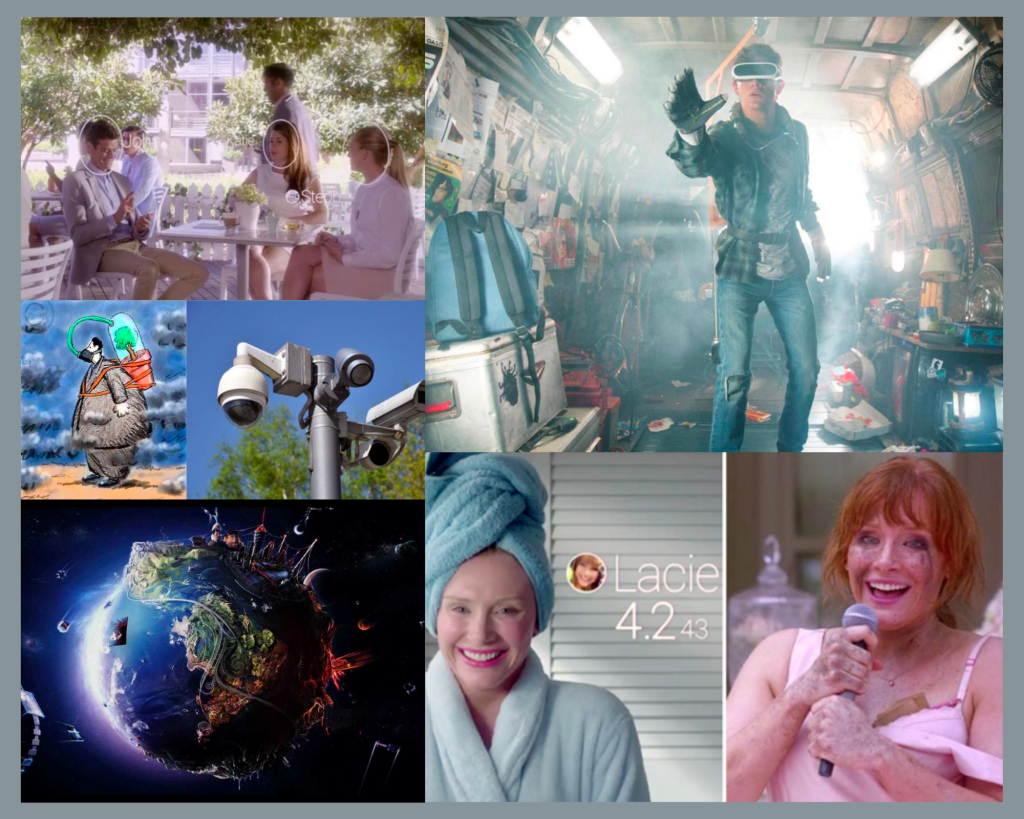
When exploring the question ‘What if we could wipe our digital footprint?‘ I referred to these two storylines when imagining the future of humanity. I created a visual reference board (as seen above) which helped me gather my ideas on how to face this question
Initial Response Thoughts and Ideas
From personal experience, I remember going on holiday in a country outside of the EU and having to have an iris scan as soon as I entered the airport. There was no option to refuse this scan, so I essentially was obliged to take it before going through. Furthermore, throughout the whole city there were cameras automatically tracking everything the public was doing. I knew this due to researching about the security and safety of the place prior to the trip. However, if I had not checked online before hand, I would have been oblivious to this intrusive and controlling technology.
There are other cities in the world with similar, if not more, invasive technology which is gathering data and algorithms from the general public without their consent, and sometimes knowledge. This invasion of privacy will most likely get worse in years to come with progressing technology and our lack of grip on controlling our own personal data. Why do we not get a say in the data the government/ people in power take from us?
Another segwaying topic I thought of was the intrusion of cameras in our homes and personal objects. Some families choose to place cameras inside their homes, but in places which examine and record movement throughout the day. This can be understandable, however we forget to truly pay attention to where this footage goes. Even in our laptops, mobile phones, I-pads etc we have cameras that (if not covered) have the ability to be hacked into and observe us. These small objects that have become a part of our daily lives are exposing us to unknown threats which we should be aware of.
The question ‘What if we could wipe our digital footprint?‘ means, what if we could restrict external data and privacy breaches surrounding us just with one action/ movement/ object?
If we could have the ability to CHOOSE to not be observed by street cameras, phone microphones, cookies etc, perhaps we will one day be able to maintain a level of privacy in the future.
Personal Privacy Range
I decided to create a range of objects which would protect your privacy by blocking device outputs that mobile devices use to record, film, sense etc. Future technology will most-likely involve holograms for items as we could steer away from using physical materials. Therefore this range of privacy would all be activated through one movement from the user. With a beam-ray, the user would activate anti-tracking technology (invisible to the human eye, but visible to machines) which will protect them from having their movement and data tracked by AI tracking in their daily lives.
In the future many people could be a part of a system which involves ranking of social status, likability and monetary wealth (in BIT coins or further advanced currencies). This society could be similar to Black Mirror (S03E01 Nose Dive) where people are ranked on their actions which then dictates their wealth and social status. Could you imagine if we could choose to switch this whole reality off and not be tracked and watched by cameras? This new Beam-ray invention would put peoples mind at ease when they decide not to be involved in the system and to just be human.
This is a speculative response therefore won’t have the typical implications that society now would have to question such as; criminal usage, government lack of control etc. Therefore this ideas is abstract and can be looked at as a way to be freely yourself without any implications.
BeamTap Functionality
The idea behind the name ‘BeamTap‘ came from thinking about how we can feel under the spotlight when having a camera on us, and spotlights are created by beams of light. Therefore BeamTap expresses the fact that the product would be tapped by the user to protect themselves from the attention of cameras and AI technology in their daily lives.

BeamTap can be used in any situation, and it uses invisible beam light technology which works to block AI technology breaches around body and objects used. The example in the photo above shows a person with and without this product. Sally is someone who doesn’t mind AI technology which face tracks, iris detects etc. Therefore she is exposed to the world and being analysed at all times on the streets and even at home if she has agreed to it. Whereas the other character (who we don’t know the name of) is anonymous to surrounding cameras and sensors as he is using Beam protect which is creating a digital wall around him to fend off external data breaches etc. He can browse the metaverse and be included in society, however he won’t have a digital profile customised with his virtual footprint.
Case Study Creation
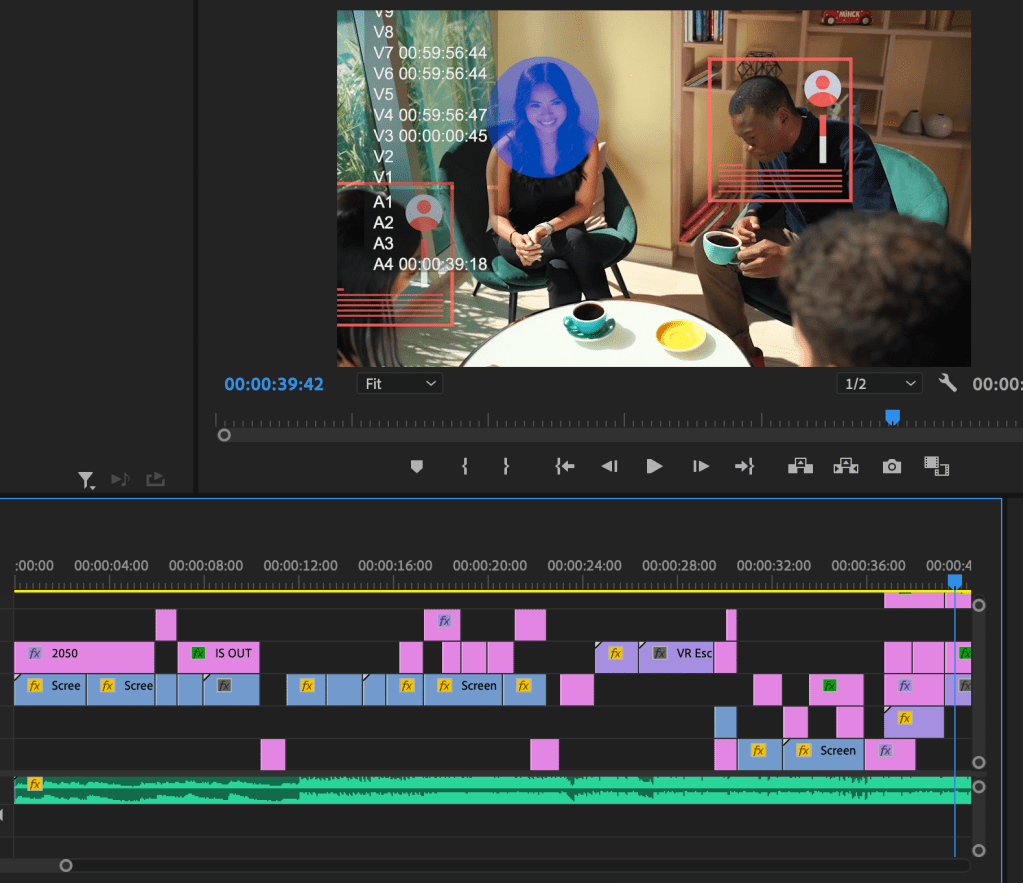
To begin the process, I sketched a brief story board and list to refer to when researching assets to build the video with. I then set up Premiere Pro with the timeline and the correct video size for Youtube.
Firstly, I wanted to set the scene of when and where the product would be used (2050). Then I built videos I collected from my AI research to express the problem the speculative response would target (cameras, social hierarchy etc). Following this the question was introduced ‘What if we could wipe our digital footprint?‘.

The video then introduces BeamTap as the speculative product response. The use is then explained through annotated clips of BeamTap users in different situations such as leaving the house, at work and socialising with friends. The first clip shows how the user activates it by tapping their palm hologram to instantly turn it on. I created each object separately on Photoshop and directly on Premiere Pro.
Text annotates the video throughout, so the viewer isn’t being distracted by a voiceover. The video then finishes with the city, the title and tagline ‘refract the chaos’.
Overall, I enjoyed this BYOB project as I was able to explore what I was passionate about and create a speculative response from it through a case-study video. This is the first time I have practised this response method and will use it again in the future. I have realised my video creation skills on Premiere Pro have become a lot quicker as I have had practise in previous modules. Knowing how to use this tool meant I was able to experiment more with transition techniques and studying about guiding the customers attention throughout the video experience.
References and Video/Audio Links
- Future city clip – https://www.youtube.com/watch?v=Iyu44eG4K1A
- How China is building an all-seeing surveillance state – https://youtu.be/uReVvICTrCM
- https://www.youtube.com/watch?v=pNf4-d6fDoY
- The Dangers of Video Surveillance and A.I – https://www.youtube.com/watch?v=1dDhqX3txf4
- Black Mirror ‘Nosedive’ – https://www.youtube.com/watch?v=4hK4fG3rcHA
- Socialising – https://www.pexels.com/video/friends-meeting-up-for-coffee-inside-a-cafe-5529079/
Music Research:
Upbeat and punchy- https://www.youtube.com/watch?v=augWXAojwEI&list=PL7pkSK1xbGD5vtXc8ouBTNiponMU8xfQ5&index=74
Background https://www.youtube.com/watch?v=QW8lnNUVLVM
 KatiesBlog