09.11.2020
Brand/ Target Demographic Research
The Duolingo Campaign was created in order to encourage young 16 – 22 year olds to learn languages using the application Duolingo. When initially breaking down and discussing the Duolingo brief with a group of fellow students, we researched and discovered many key insights regarding the target demographics relationship with learning languages. Talking with other people about the same brief helped develop further ideas which lead onto deciding possible routes to take for the campaign.
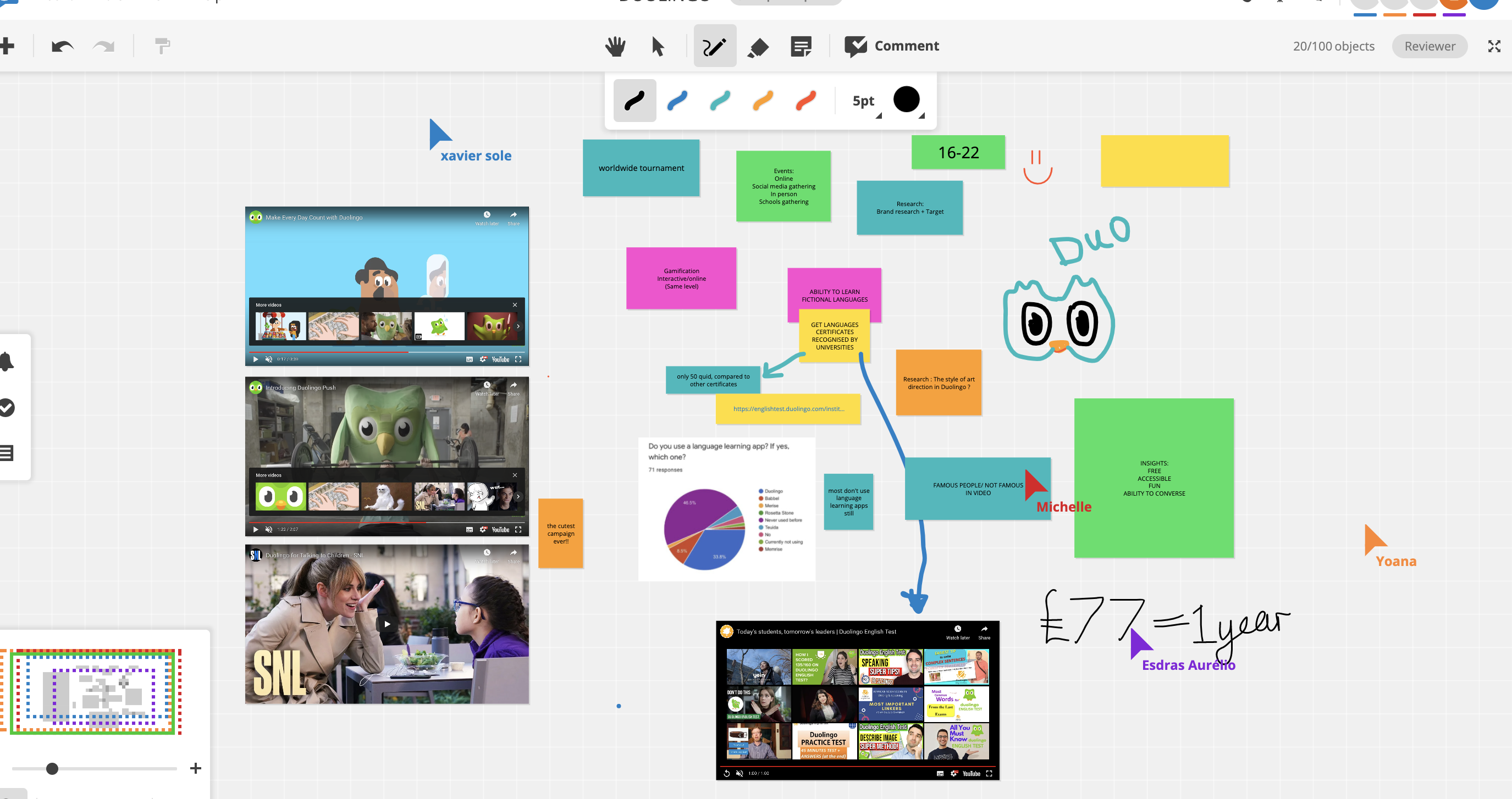
The main insights we found during the discussion:
– Gen Zs needs to learn a language and have easy accessibility.
– The target demographic wants free education, a fun way of learning and the ability to converse in the language (with no barriers, embarrassment etc).
Considering the needs and wants of our consumers, we discussed our individual campaign ideas in order to gain further inspiration for our projects. The team discussion lead to learning additional facts about Duolingo, such as:
- Duolingo offers language certificates recognised by universities which cost 50 pounds compared to other language boards which charge £100+
- The company featured in SNL and other famous channels mocking language learning
- Duolingo and Angry Birds have had a partnership in a past campaign
Discussing our prior audience research meant we could better understand the target audience and decide on which routes to focus on for our individual campaigns. This demographic looks for free products, but would be willing to spend extra if it was a worthy investment. Due to the age range being from 16 to 22 years old, many within this bracket would be either finishing school/ studying at university or working, therefore the concept of saving money shows to be a priority. Involving the fact that the basic Duolingo is FREE would be a key point to cover and would increase user engagement.
Gen Z’s are highly technology based, therefore the use of gamification will increase interest and build the ‘pleasure’ aspect of learning. Fast Company’s article ‘Do Gamified Education Apps Actually Help You Learn’ discusses this educative approach and explains the positive aspects of using gaming in learning. Gen Z’s crave interaction and entertainment, therefore this Duolingo Campaign needs encourage the audience to interact with the product while being entertained in the process. Duolingo has successfully turned learning a language into a game. In order to promote this factor, possible routes to take would be holding events and challenges online (social media gathering), in person (e.g. schools gathering) using gamification, worldwide tournaments etc.
Having conducted an online survey and online focus group, I discovered how Gen Z’s have many ‘blocks’ when learning languages. In this Campaign, I have included insights from this research in order to tackle the issues and find possible solutions.
Initial Campaign Ideas
Referring back to the the main brief requirements helped to ground my concepts and discover the core insight of the campaign. Thinking about previous Duolingo campaigns helped ignite further inspiration. ‘The Team-Up’ campaign was created partnership with Angry Birds where they played with the concept of frustrations of notifications and creating a dramatic scene behind it ‘You wouldn’t like Duo when he’s angry’.
Seeing this inspired me to explore similar ideas but using grammar as the enemy rather than a figure from an external company. Considering the market research conducted for this demographic, the importance of entertaining the audience is crucial otherwise there will be a lack of interest. If the audience doesn’t feel connected with the brand/ message, the meaning and purpose of the campaign would be lost.
3 Initial Ideas
Grammar Enemy | Fight Back with Fluency
Idea – A comedy stunt around the concept of fighting fear of grammar
Insight – Fear of grammar
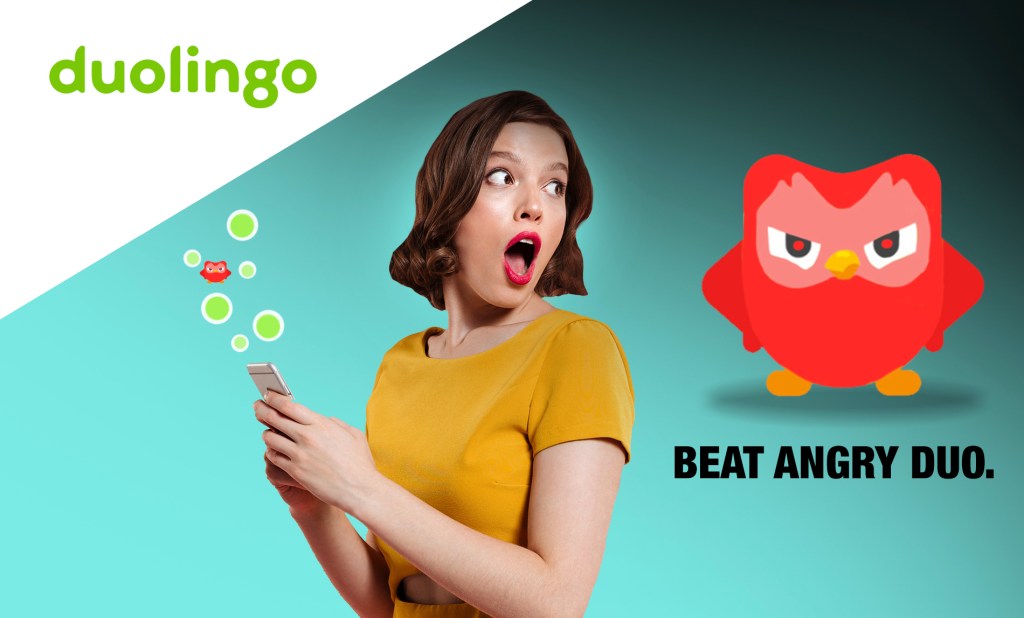
The first idea that came to mind was to have an advert where Angry Duo, an angry/ irritating character (representing grammar), pops up and chase the user when a mistake is made (representing the fear factor when confronting grammar). Then, when the user uses the Duolingo app, she is able to face the enemy by shouting at him in another language to fend him off. The more knowledge, the more power. This would be made in the form of an advert and potentially a game (on the Duolingo app), helping demographic to fight their grammar fear.
A following idea was to have a street stunt where people have the power to get rid of angry Duo by using the app (or throwing green Duo balls at angry Duo).
References
1 – Inspiration for angry duo
The Verge Duolingo Design Page
2 – Photo of shocked woman – taken from FreePik (Copyright free photos)
Freepik Shocked Woman
DuoTalk | Conversation challenge
Idea – A conversation-based campaign collaborating HelloTalk and Duolingo, encouraging conversation with languages
Insight – Survival communication methods force learners to use a language
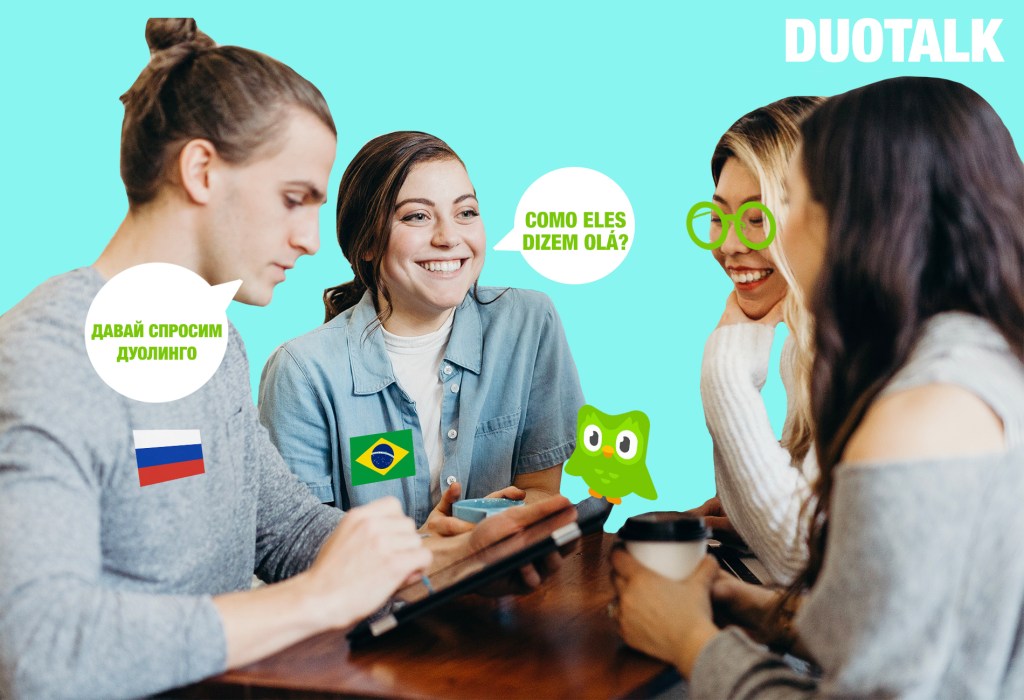
A room of 5 people (within demographic) are given a challenge to solve (such as a murder mystery) which can only be solved by understanding and communicating with each other in their own languages. Having only the app as their language guide, they have to break the barrier of communication by learning and finding ways to understand each other without using the internet (Google). Each member of the group would be paired with people who speak languages unknown to them, this way language learning will be enforced. The challenge would be filmed and created as an advert, and would encourage the audience to try it themselves.
An online version of this game would be available for schools/ universities where students (with student logins) could connect at random with other students across the world and complete random group tasks.
DuoTalk wouldn’t just be a game, but also a platform which has the option of connecting via messenger in order to encourage friendship and connection worldwide. Considering the prior target research, the demographic crave interaction and communicating with others, therefore this idea meets their needs. When self-teaching myself Italian, in the early stages I used the apps Duolingo and HelloTalk to build up my vocabulary and to chat with local Italians. HelloTalk was fantastic for boosting confidence in the language and getting to know real Italians across the world.
Learning a language through interacting with games and writing/ speaking with locals really helped develop my language skills. This is where the idea ‘DuoTalk’ came from, combing two learning techniques to create a fun educational challenge.
References – Group Visual – taken from Unsplash (Copyright free photos)
Duolingo Fluency Filter
Idea – What would you look like if you spoke Spanish/ Chinese/ Dutch fluently?
Insight – The fear of speaking in a different language

The Duolingo Fluency Filter shows users what they would look like if they spoke fluently in another language. When the user moves their mouth (pretending to speak) a sensor picks up this information and a voice over speaks intime to the users lip movement. Before using the filter, there will be an initial option to choose the language and accent to speak with This filter will be accessible on social media platforms TikTok and Instagram. This filter is entertaining, engaging and shows the user what they could look like if they spoke other languages.
In the target research, many participants stated that they are too afraid to make mistakes in other languages so they shy away from trying all together. This confidence issue needs to be confronted, and ‘mocked’ in order to get past the fear factor of learning/speaking in another language.
From personal experience, I can understand the fear in making initial mistakes in a language, but knowing that I could eventually be fluent and be able to communicate with people from another culture was what encouraged me to keep going. The demographic behind this campaign crave interacting with new media, therefore creating a language learning filter would be a strong idea.
References – Photo of woman taken from FreePik (Copyright free photos)
References for 3 Ideas
Angry Birds X Duolingo | The Team-Up! – Past Duolingo Campaigns
Duolingo Survey
Language Learning Focus Group
https://www.youtube.com/watch?v=nxrKhil9wOw – Duolingo English test
Duolingo banner (top of page)
Feedback + Further Development
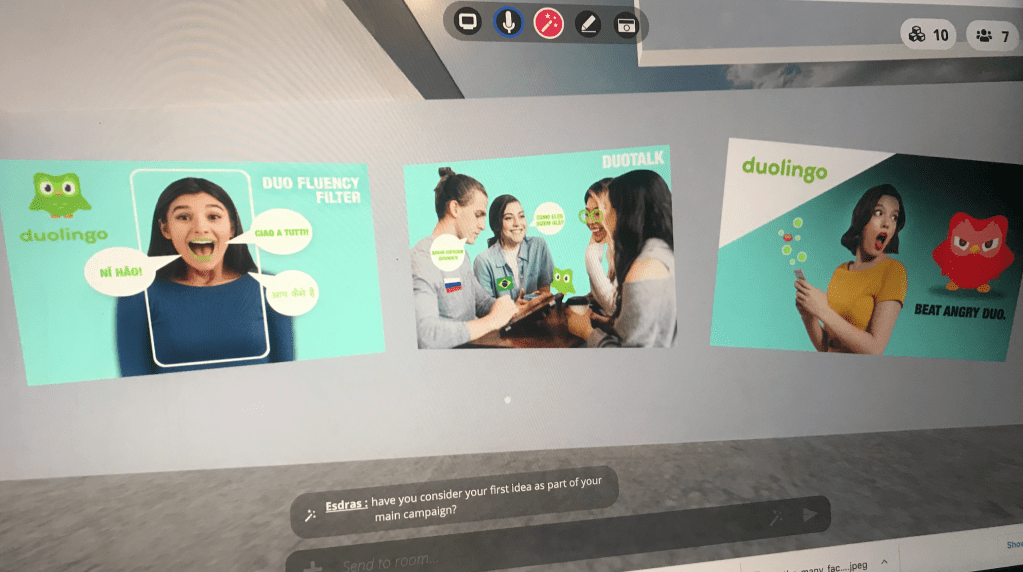
After having presented the campaign ideas to the course lecturer and class in my Mozilla Hubs VR Exhibition Room, I was informed of ways to further develop my ideas.
The main points of the session were:
- The 1st and 3rd visuals have the most potential as they meet the briefs requirements.
- The 2nd is out of the brief, but the idea is strong. The 3rd idea can be incorporated within the campaign but not used as the main idea.
- The campaign should encourage the target audience to use Duolingo, not improve it. The idea shouldn’t be in the app, but to help promote it.
- Stick to one concept – ‘The more mistakes you make, the better you become’. Break the fear of making mistakes (flip it so it isn’t negative). The main idea is too negative, and the audience needs a positive boost. The Angry duo could be used as a joking tool instead of a negative character.
Moving Forward…
‘Don’t be afraid to make mistakes’
Taking this feedback into consideration, I made a list of all the different ways the campaign could go down and picked the strongest options. I decided to conduct further research on the concept ‘stopping fear of making mistakes’ in order to gain inspiration and strengthen my ideas.
Inspirational Videos
16.11.2020
‘Don’t be afraid to make mistakes’
A common fear amongst language learners is the fear of making mistakes. This insight needs to be confronted and ‘played with’ in order to turn the fear into a positive factor when learning a new language.
This topic is highly relatable on a personal level, so I believe this will be also enriching moving forward. Holding the focus group highlighted this insight, therefore this campaign will have a positive impact on the target audience. This demographic are more likely to engage with a product/ campaign if they see its potential benefits.
Second Development Stage
Taking the first feedback into account, I further developed my ideas by thinking of ways to turn a seemingly negative concept into something more cheerful and relatable. A helpful way to approach this second development stage was to write down the feedback received alongside potential ideas in order to improve them.
Making a mockery out of something you’re afraid of can make you feel as though the fear can be overcome. Therefore I decided to use the Duo character as the main focus of the campaign, and to change his personality according to different types of language learners.
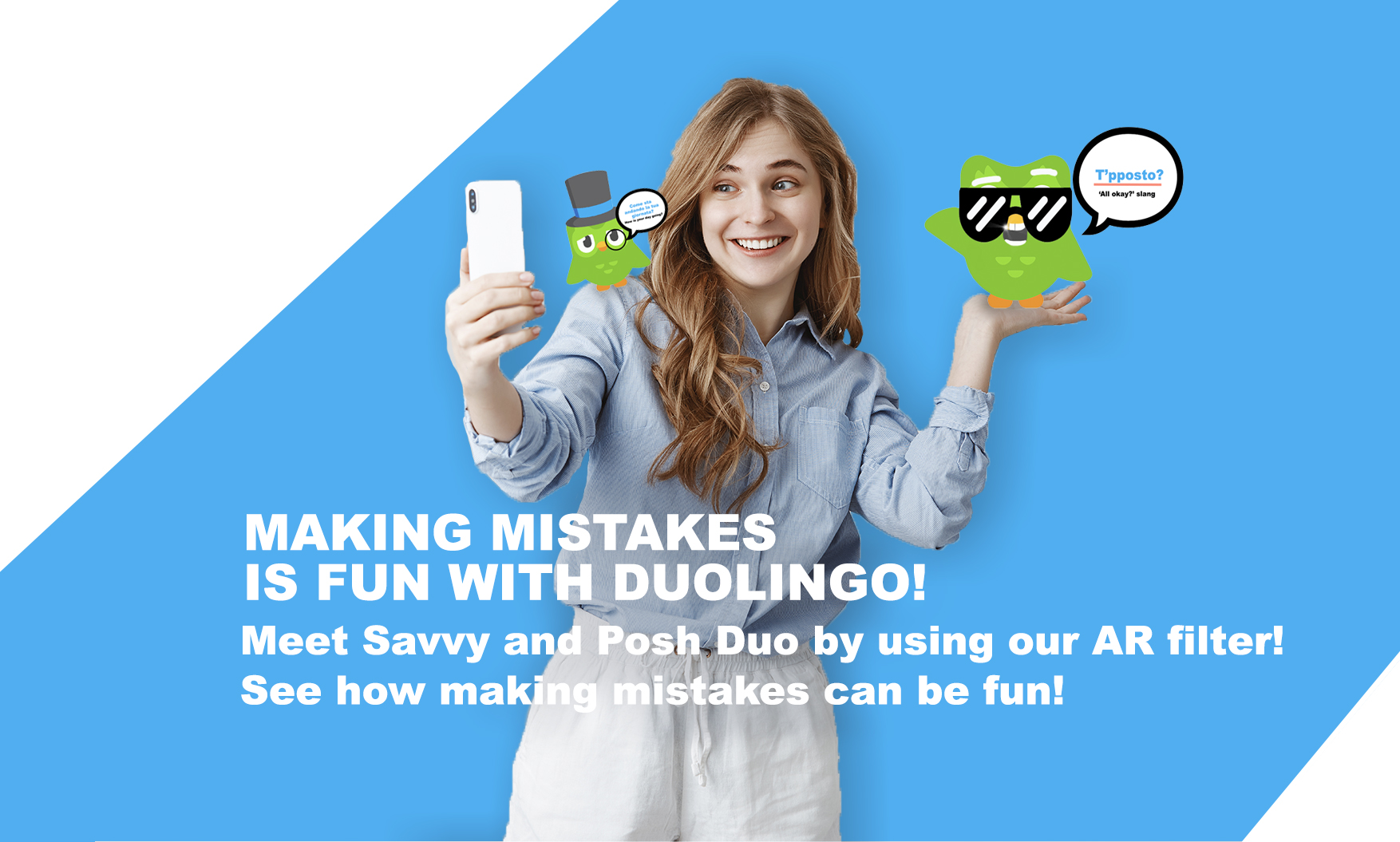
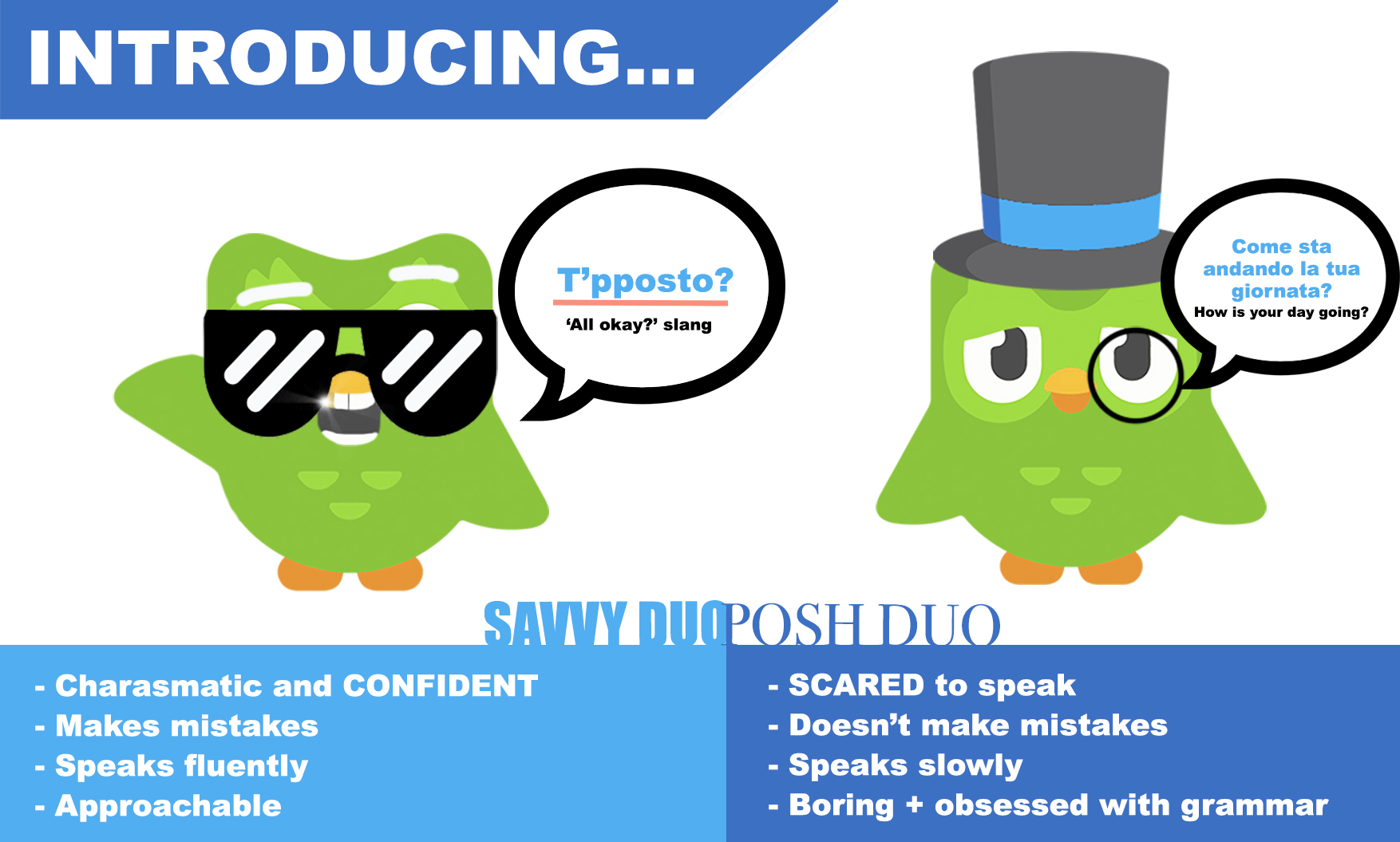
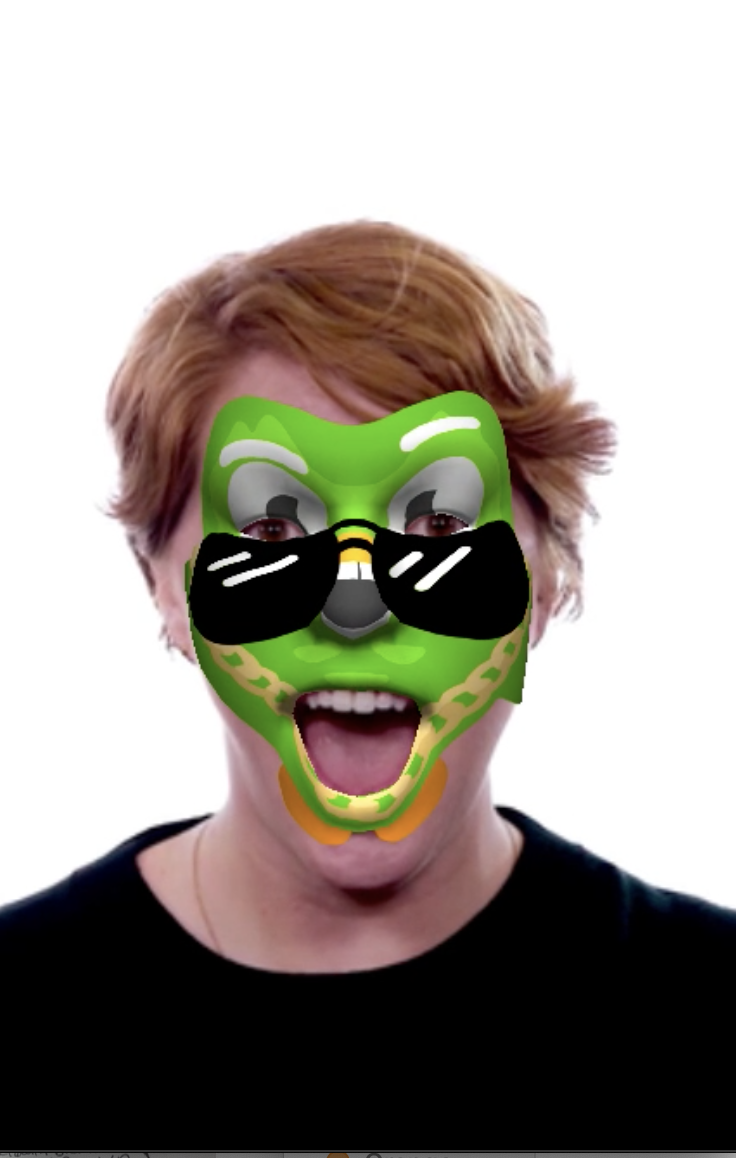
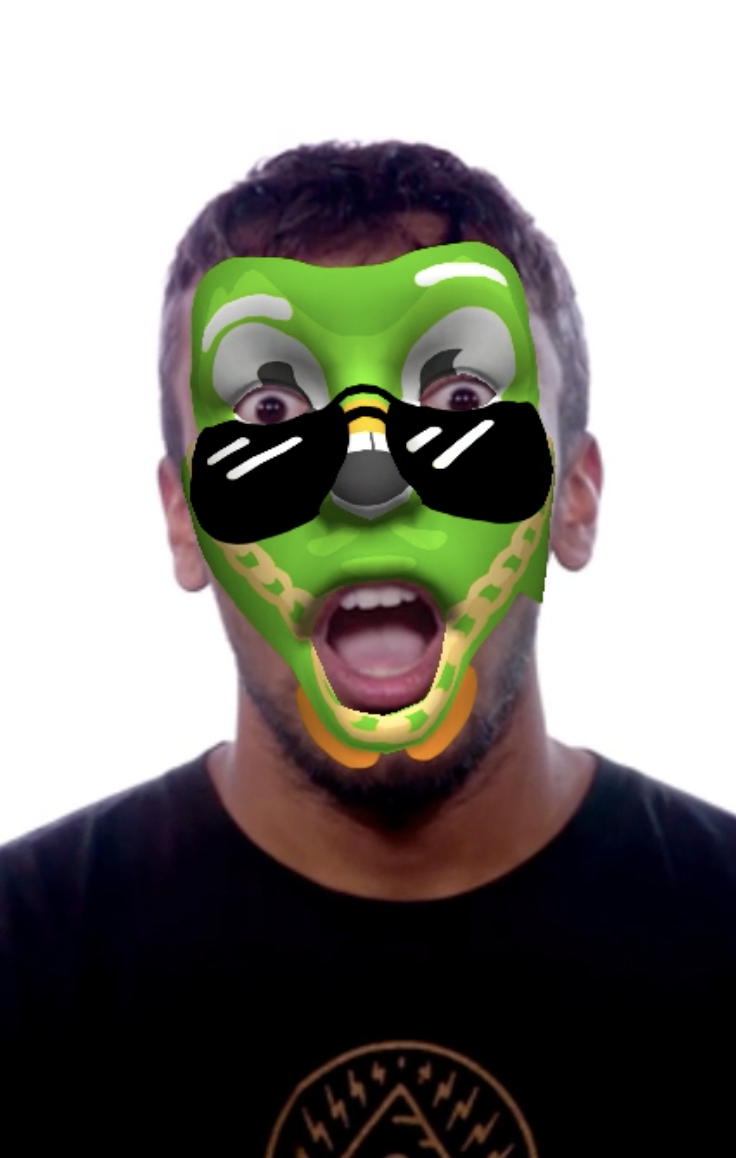
Thug Duo – A charismatic and confident language learner who makes mistakes but doesn’t care about them. He speaks fluently using slang and shorter sentences which makes him entertaining to speak to as he doesn’t worry about the judgement of others. Despite the errors, he is approachable and has no fear to try out new languages.
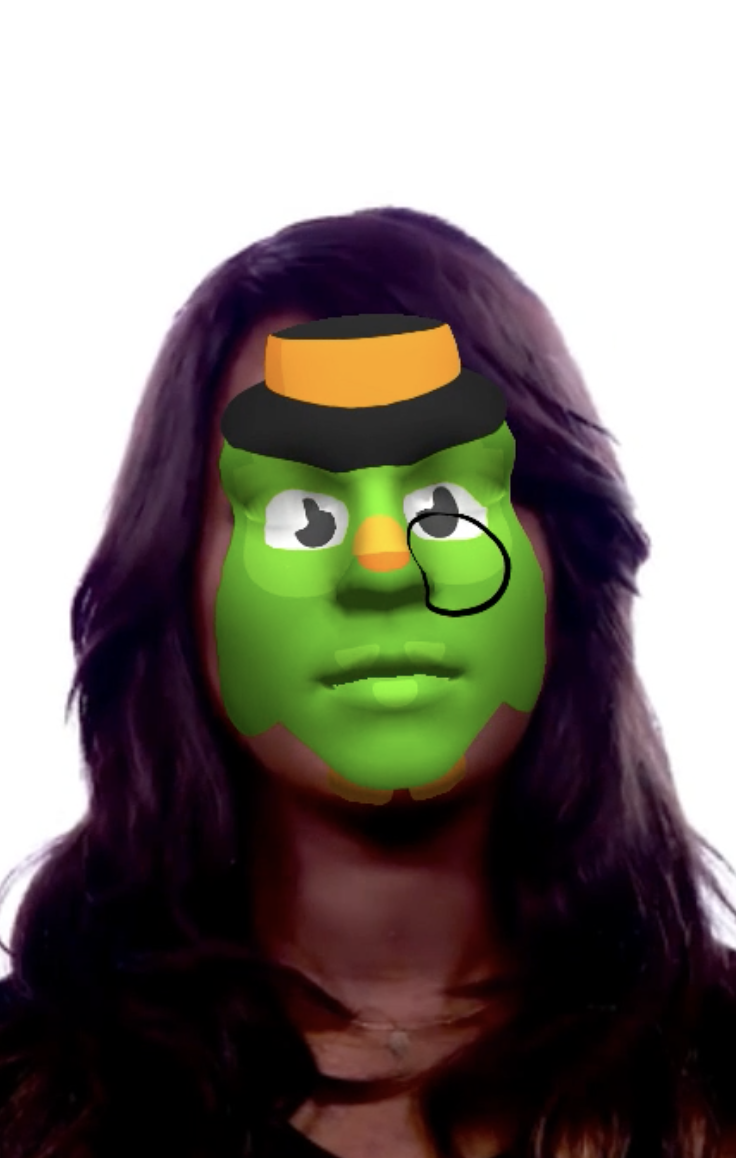
Posh Duo – A sullen and rather boring language learner who speaks grammatically correct in any language however is hard to follow due to talking at a very low pace. Despite not making any mistakes, Posh Duo is scared of tripping up on errors and therefore speaks slowly and uses longer sentences in the process.
23.11.2020
Brainstorming and Action Plan
Continuing on with the campaign, I brainstormed different routes to take when considering the digital, physical and video part of the submission. The thinking process was made by writing a list of all the possible routes to go down within each section, and to filter down the routes which would be best suited to this campaign.
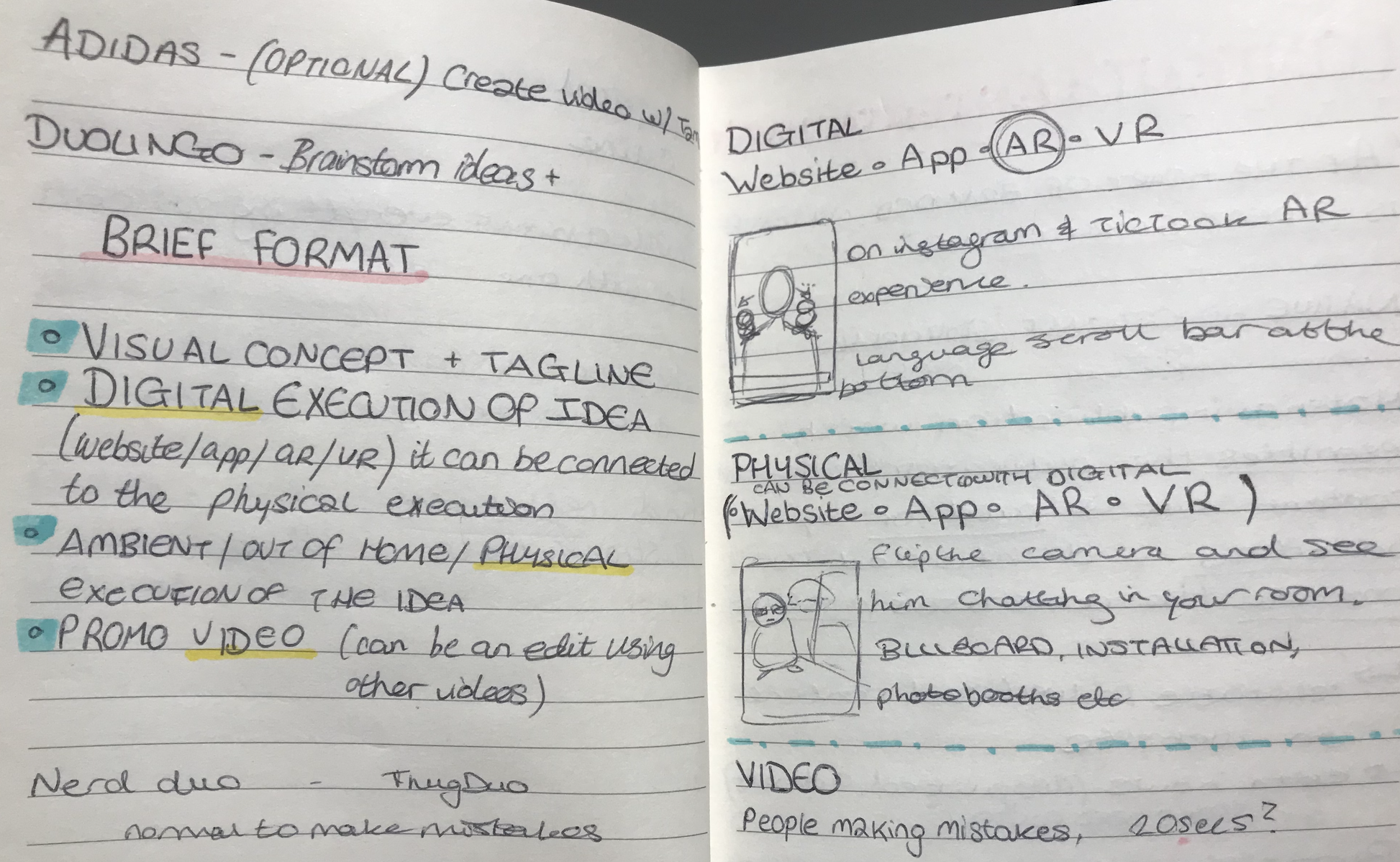
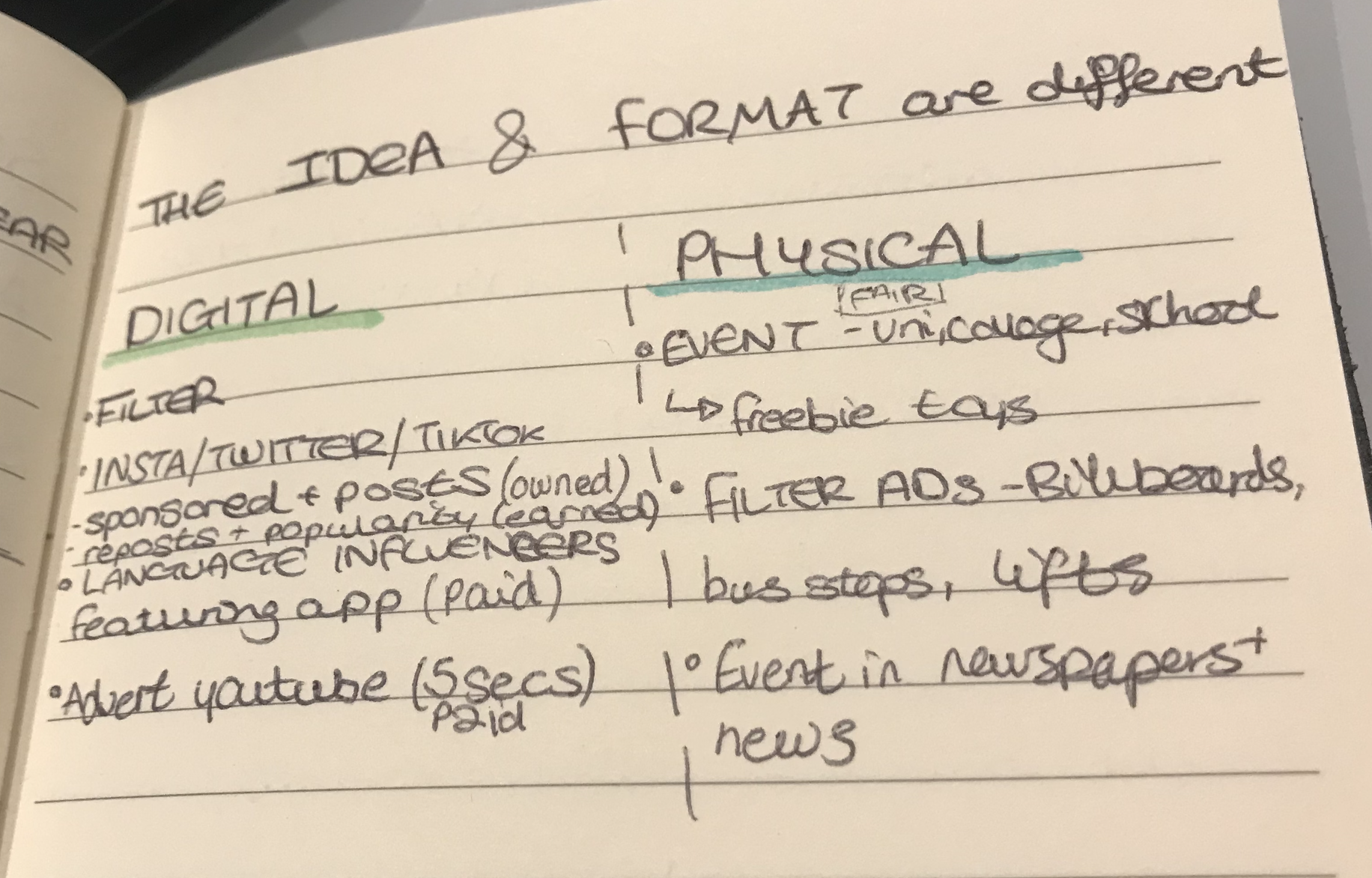
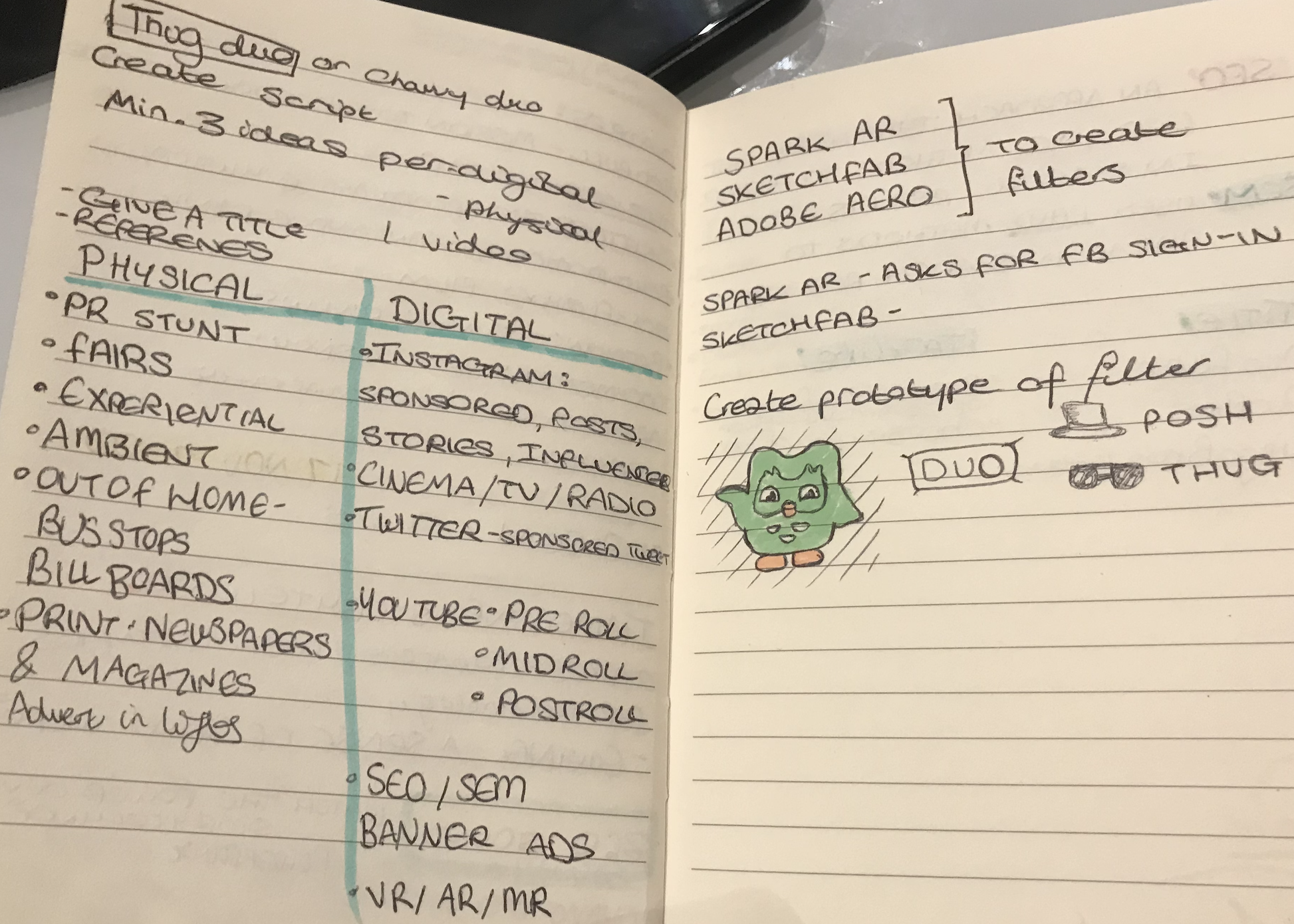
While weighing up the importance of each potential path, I wrote down possible titles and tag-lines for the project…
Titles
- Duofilter
- DuoBros
- LingoBrothers
Taglines
- Break the fear of communication
- Choose your Duo Trainer
- Build your confidence, choose your bro
Clearly identifying the possible titles and tag-lines for the project helped build a foundation for the project. The decision for the title was ‘DuoBros’ and the tagline ‘Choose your Duo Trainer’. The brief asks for a digital and physical interpretation of the campaign, therefore I listed the possibilities best suited for the DuoBros, and considered POEM in the process.
Digital
- Filter (owned)
- Instagram/ Twitter/ Tiktok (teaser, launch and sustain) advertisement
Posts (owned) = Reposts and popularity (earned) - Language Influencers (YouTube) featuring app (paid)
- Advert on YouTube, 5 seconds (paid)
Physical
- Event, outside Universities, Schools and Colleges in major cities in England
Freebies with toys (from downloading Duolingo), Giant DuoBros filter screen to interact with and actors dressed as PoshDuo and ThugDuo (paid) - Outdoor advertisement on billboards, bus-stops and in lifts (paid)
- Event gaining interest in national newspapers such as The Daily Mail and The Times (earned)
- TV news report and interview from gained publicity (earned)
Making a clear list of steps to venture down greatly motivated me when progressing to the next stage.
Digital Media
DuoBros Filter
To start the process of making the DuoBros filter, I researched the main ways to create a filter to post on Instagram/ Facebook. The most used programs are: Spark Ar, Sketchfab and Adobe Aero. As I looked into the functionality of each app, Spark Ar seemed the most suitable for the process I needed to take. Having downloaded the program and logged in through Facebook, I watched YouTube tutorials to better understand the software.
Having gained a basic understanding of the program, I tried to replicate my original filter idea which was having PoshDuo and ThugDuo on each shoulder where they move when the user turns their head side to side. Every head tilt would trigger a pre-recorded script of a phrase spoken in a different way for each Duo (slow and lengthy for PoshDuo, and quick and witty for ThugDuo).
This idea was fun to develop, but proved to be very difficult to recreate. I managed to create two ‘canvases’ that connected to a face tracker but I had no success in having them move according to when the head tilted towards it. I experimented for hours while researching online different possibilities in order to tackle this problem.
Unfortunately I had no success, and therefore had to re-consider my idea. The most successful filters on Spark Ar are mask types which move with facial movement.
Creating the Face Filter
After having watched the inspiring Face Mesh tutorial, I decided to create a mask myself with the PNG Duolingo files previously created.




In order to do this I followed the ‘How to create a Screen Tap…’ video and managed to create successful filters. To make the DuoBros aligned with the models face, I had to bounce back and forth from Photoshop to Spark Ar to get the proportions right. The faces of the Duo birds looked scary at the beginning and didn’t fit the masks measurements. After experimenting for a while, the filters managed to look a lot better.
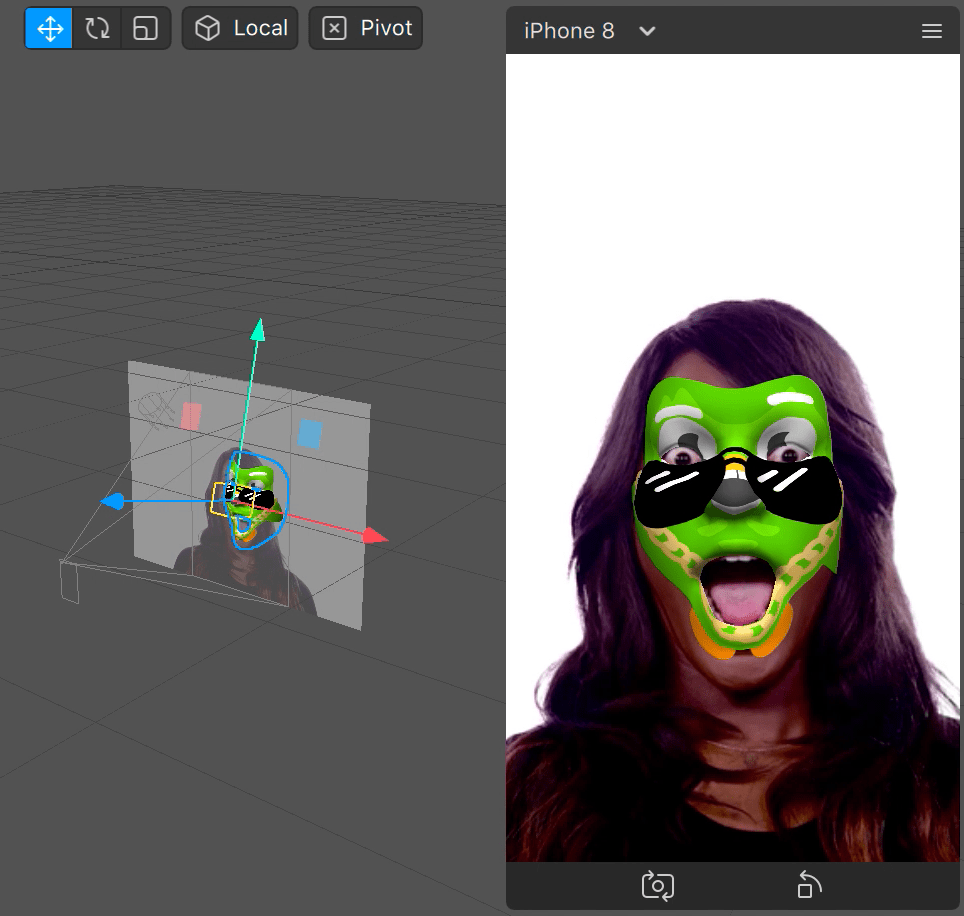

DuoBros Filter (First Review/Change)
Receiving feedback on the filter clarified it didn’t follow the main idea of the campaign which I agreed with. I discussed with my tutor how I can accomplish the principle idea (of having a duo on each shoulder and interacting with them), and he said how the filter needs to be as near as possible to the main idea and could be modified on the video submission.
Moving on, I recreated the filter with the original idea and positioned the birds next the model’s ears instead of the shoulders which worked better. In order to adapt the functionality of the filter with the intended purpose, I created it as near to the original idea and republished it.
Once the project was saved and published on Instagram, I asked my friends and family to try the filter on their social media channels. The feedback was positive, and they enjoyed using the filter.
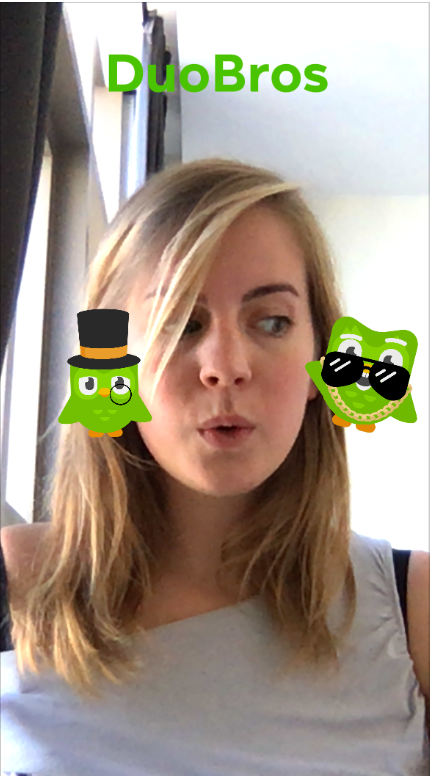
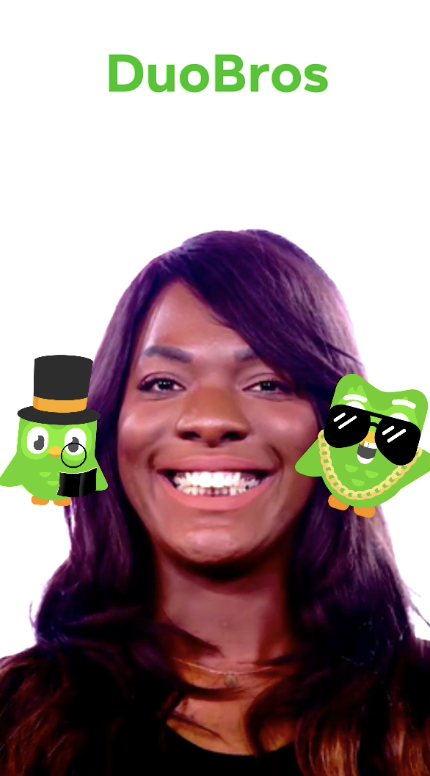
LINK TO FILTER: https://www.instagram.com/ar/699965870919580/
THE VIDEO
Before creating the video, I wrote down the steps I needed to take.
- Create a timeline of scenes
- AUDIO RECORDINGS of different languages: Casting, recruiting and editing
I casted 6 friends with 5 different languages to complete voice recordings, asked them to record 2 phrases (with a similar meaning) using a ‘posh’ and ‘thug’ style - VIDEOS of filter being used: Casting, recruiting and editing
I considered using animated and enthusiastic actors for the roles - Create the VIDEO on After Effects: Considering colours, duolingo characters and time-frame (52 secs)
- VOICE over for video: Scripting and recording
- MUSIC for the background of video
The Script/ Audio Recordings
The script and audio are important parts of the DuoBros filter, therefore I chose 5 of the top spoken languages in the world (Spanish, Italian, Chinese, Arabic, English) to show examples of how it would work. The principle sentence of the DuoBros exclamations was ‘I’m good at speaking ___ ‘ (the language).
When creating the scripts, I discussed the best suited local/ colloquial phrases to use for each language by speaking to friends from different countries who knew the most accurate adaptations of the sentence. Regarding the voice-type, the Duo character appears to be male so I purposefully chose male voices.
The message sent to each partaker:
‘Hi ___! I am looking for a man to record himself saying two phrases in ___.
One recording with a posh, slow voice and the other with an edgy and ‘gangster/chavy’ accent. Would you be willing to do it?’
Casting
Spanish: Josè and Alessandro (Columbian)
Italian: Alessandro and Marco (Italian and Sicilian)
Chinese: Luke (Chinese)
Arabic: Waleed (Australian/Jordanian)
English: James (Wales)
Scripts
English:
P: My level of English is rather high considering ones grammatical accuracy
T: I’m well good in English init!
Italian:
P: Sono oltremodo basita dalla celerità con cui la tua mente acquisisce una nuove nozioni
T: Min**! Brava sei!
Spanish:
P: Mi nivel de español es bastante alto teniendo en cuenta la precisión gramatical.
T: ¡Soy bueno en español! ¿No?
Chinese:
P: 我觉得我的英语应该还是不错的
T: 我觉得我英语水平应该还可以吧
Arabic:
P: مستوى لغتي العربية متميز جدا نحويا
T: انا كويس بالعربي
Audio Recordings
When the audio clips were received from each person, the pitch and tempo of the clip were raised in order to sound more bird-like for the duo characters and then the files were later added to the video.
30.11.2020
Feedback Session
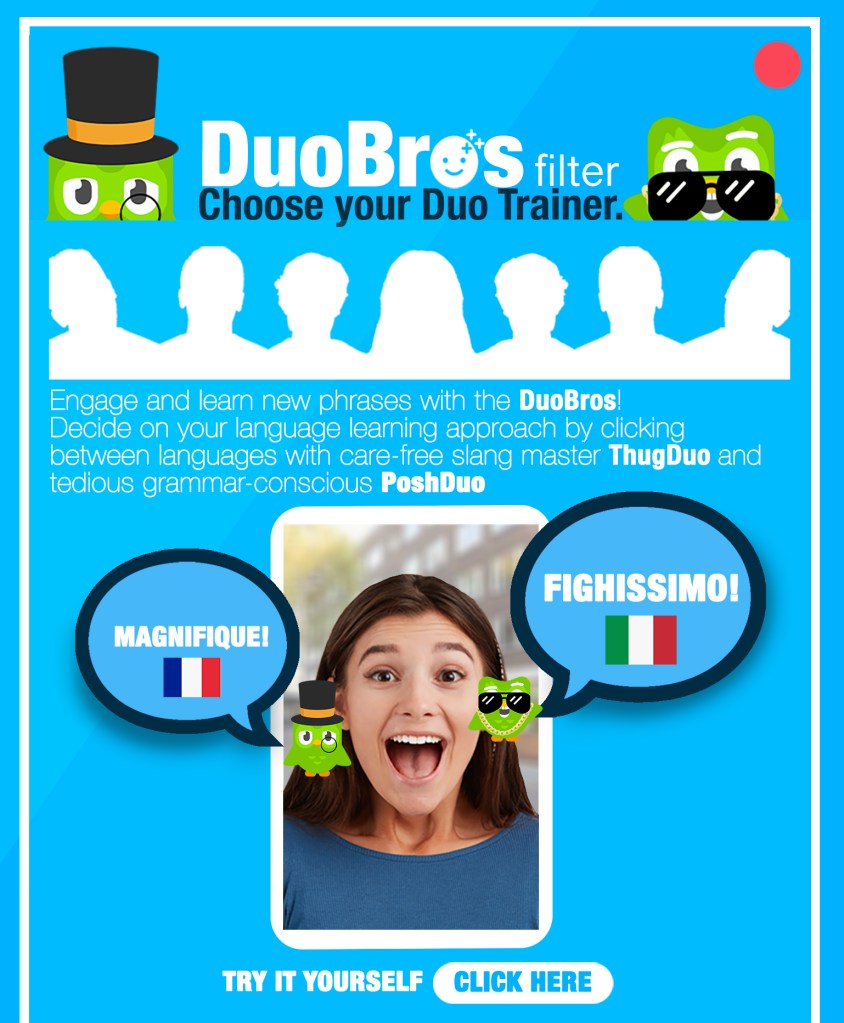
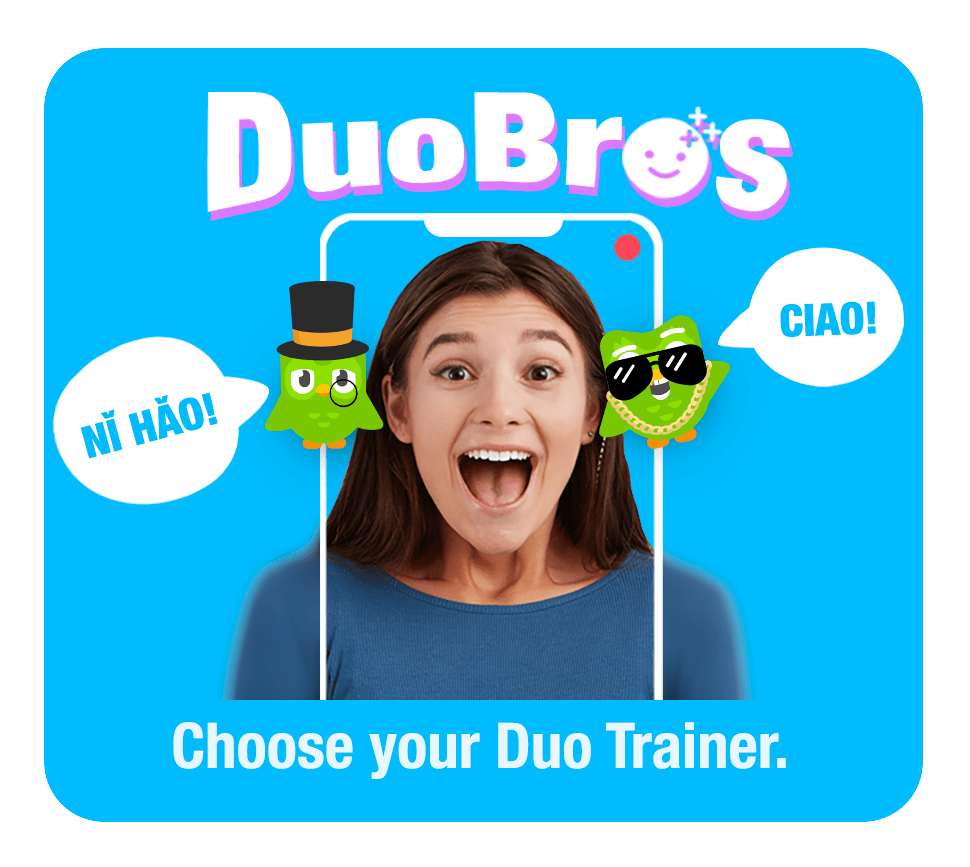

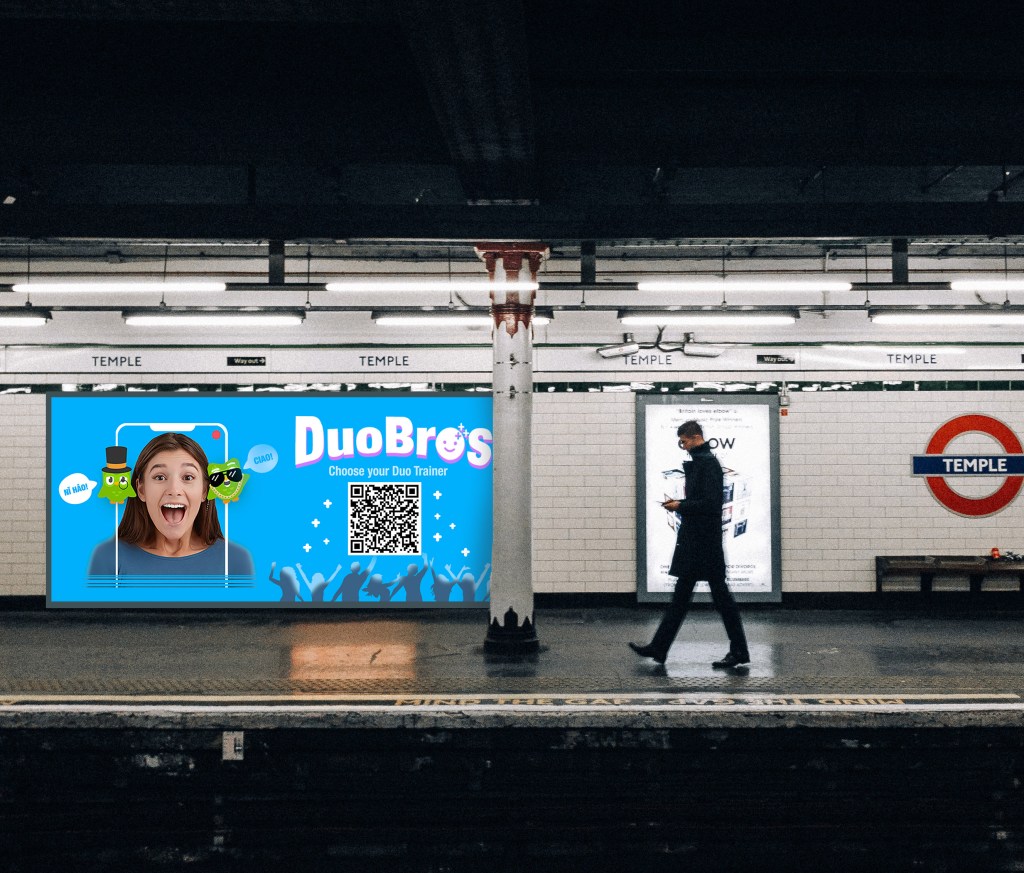
Throughout this week I managed to prepare most of my OOH (physical) and digital visuals. Having prepared these visuals meant I was able to get further feedback on my campaign progress from my two lecturers.
The feedback given:
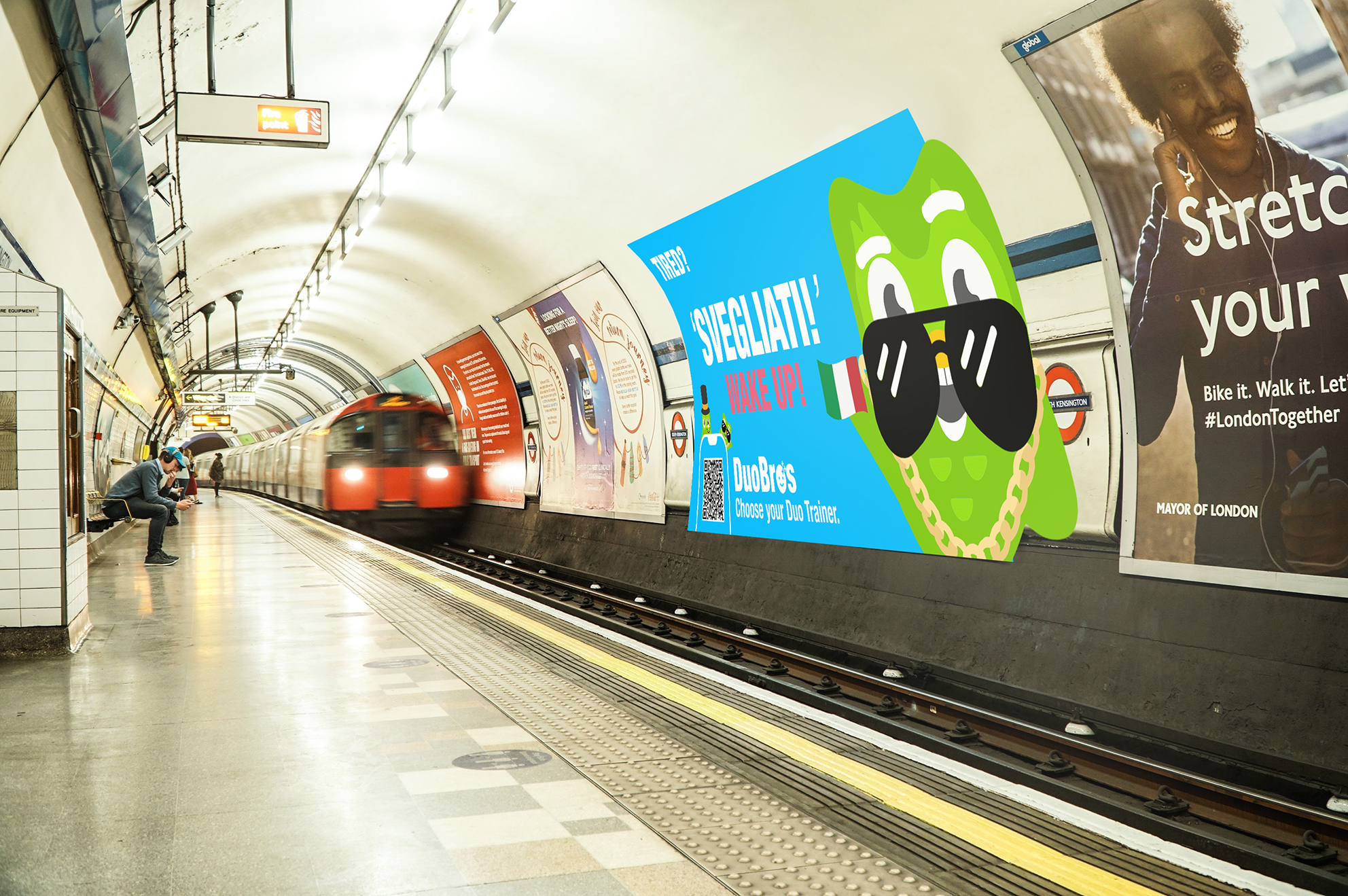
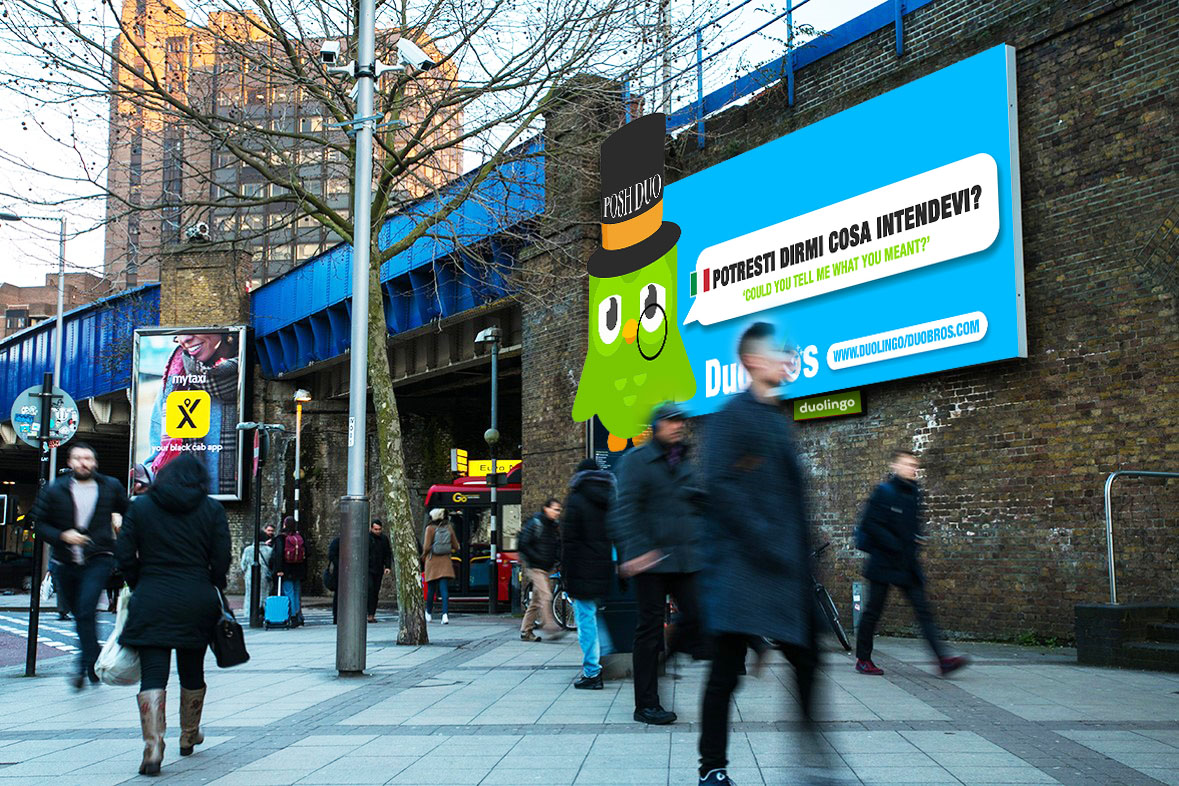
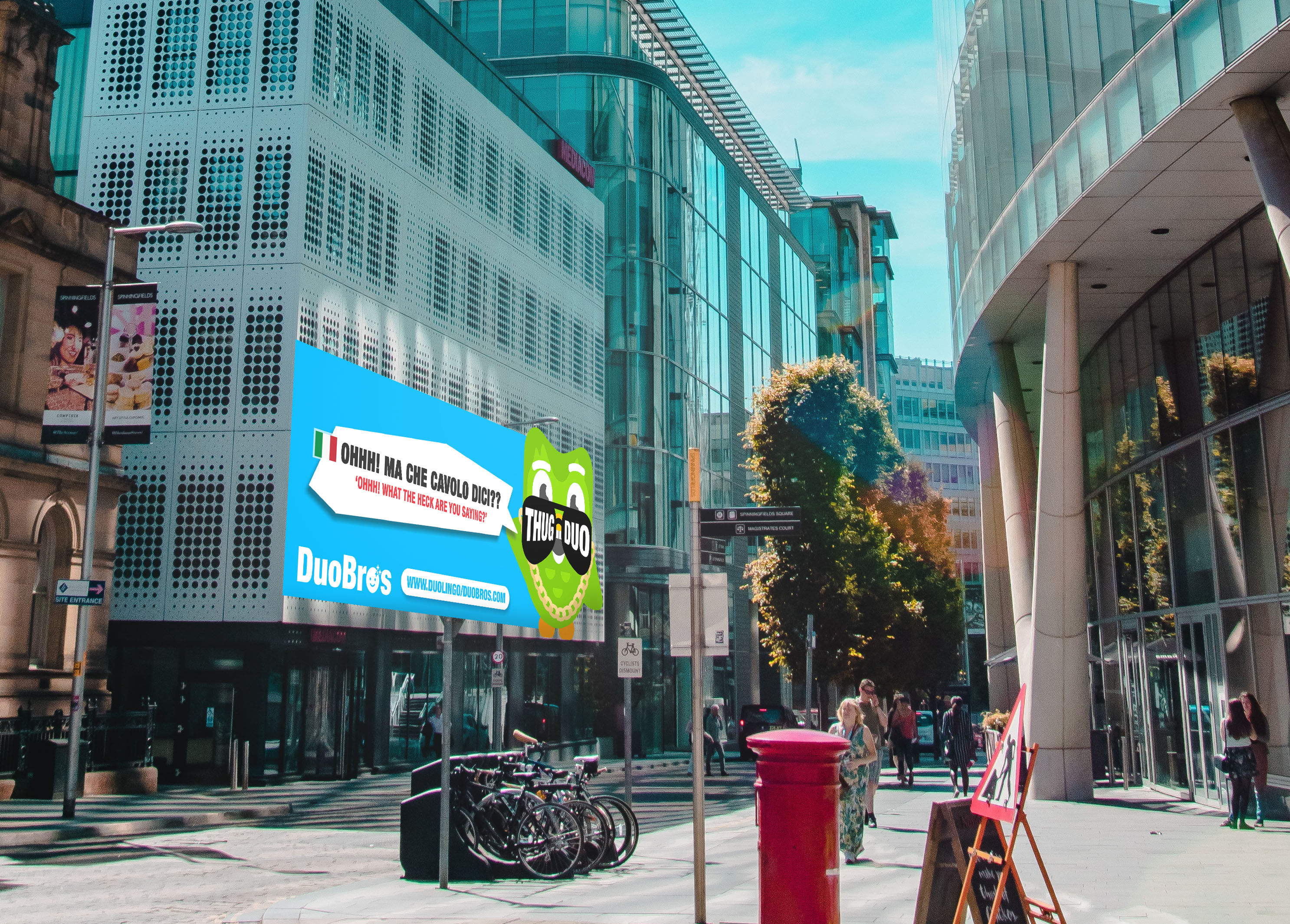
- The outdoor visuals need to have different visual purposes, i.e. the billboards could have one quote from each bird. – This idea sparked more ideas, like playing with the shape of the banner (into the bird shapes). Also an idea came to make them more visually striking and engaging.
- The event is too predictable, it seems corporate. There could be a rap-battle or something more stimulating?
- The insight isn’t very clear, you need to advertise it more in the work
Following on from this feedback, I decided to recreate my visual concepts to make the insight clearer and more impacting.
Out of Home
The University & College events will take place all across the UK for one day at the start of the campaign. The event will consist of a banner advertising the campaign, two actors in giant DuoBros costumes who will communicate with the students in different accents and languages, a giant screen linked to the filter for customer interaction, QR codes for CTA, Duolingo helpers to guide and discuss Duolingo with students and music in the background to set a ‘feel good’ atmosphere. Freebies of mini PoshDuo and ThugDuo will be offered to audience who download, or show they have Duolingo on the day.
This event will create organic word-of-mouth interest when students understand how entertaining and addictive the DuoBros filter is. Once the filter is used, discussion will lead to further brand awareness for Duolingo.
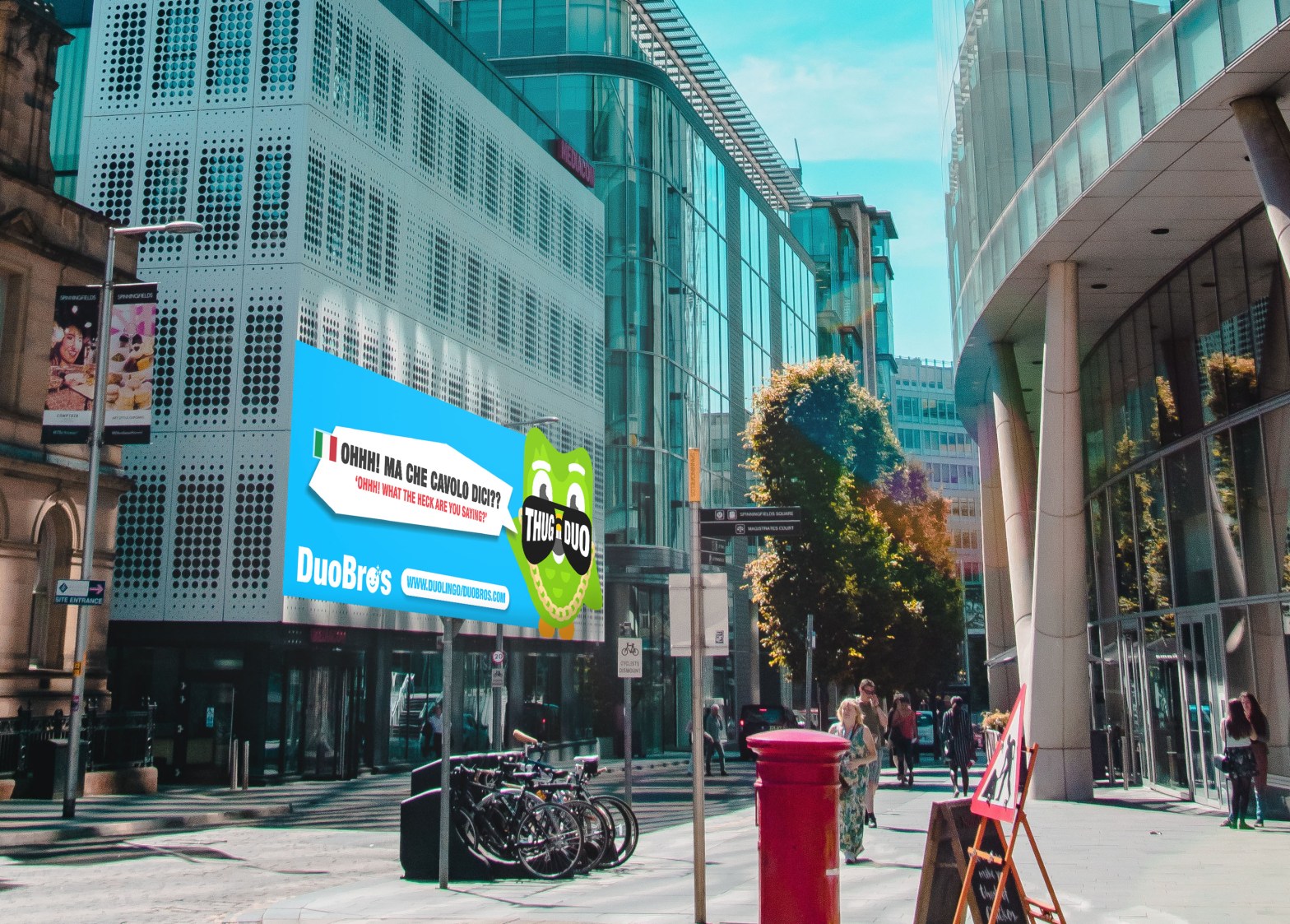
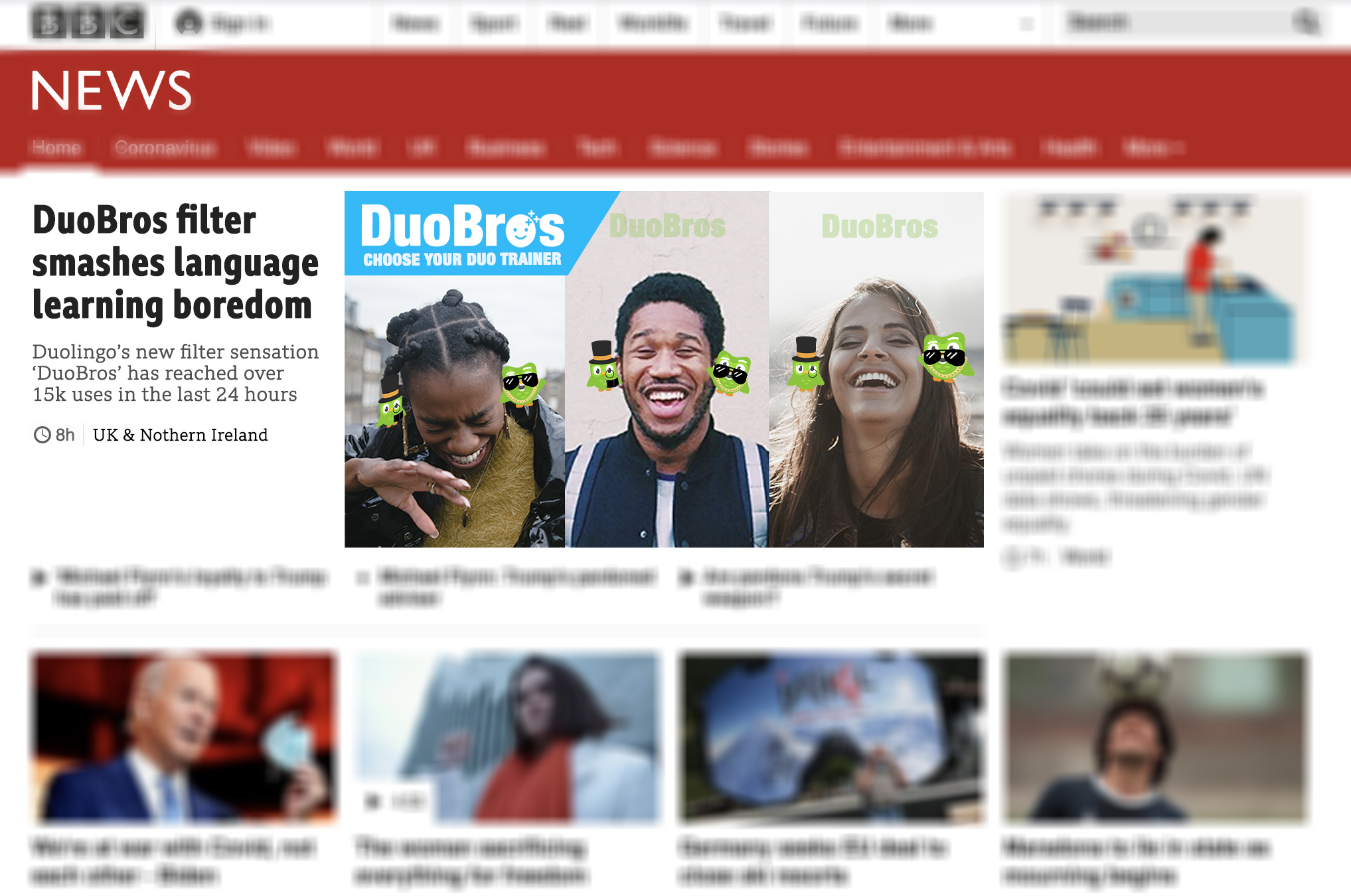
The OOH billboards and banners will be shown across major cities in the UK for one month. Their bright, bold visual appeal will catch on-goers attention and will direct workers/commuters to downloading the app and using the filter. The BBC News visual demonstrates the viral potentiality the DuoBros will have and how the campaign will look across the news.
The Final Visuals
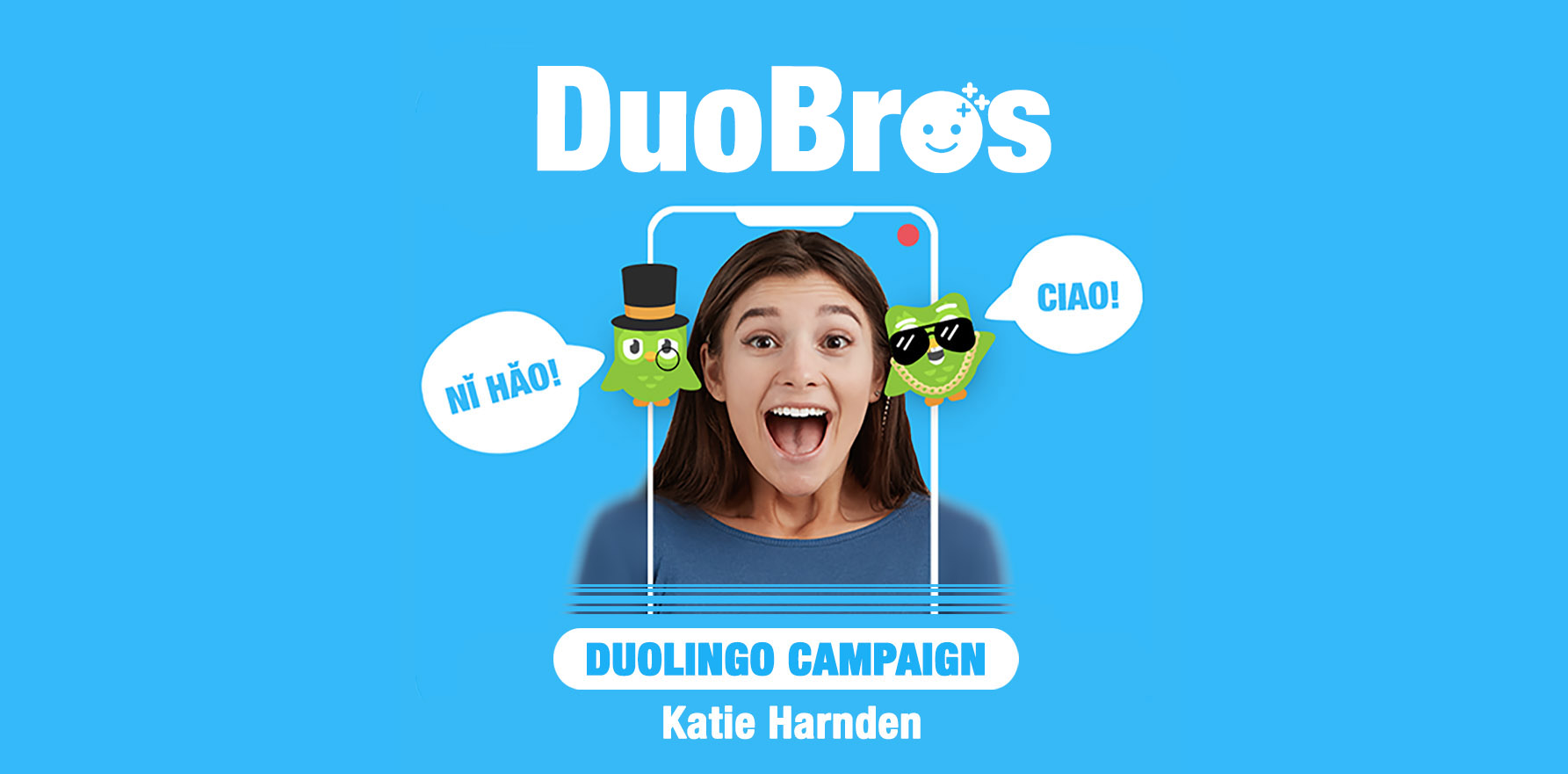
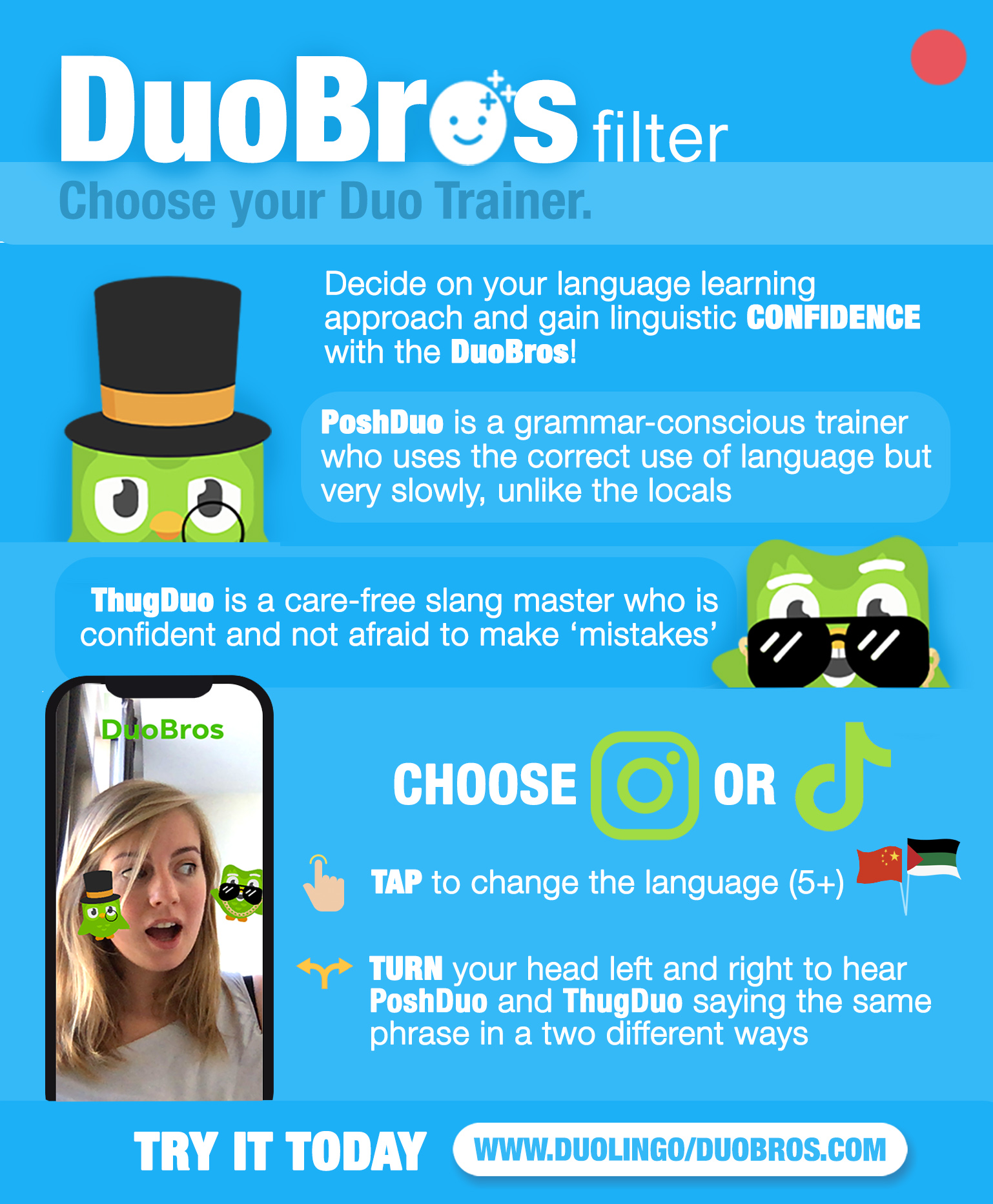
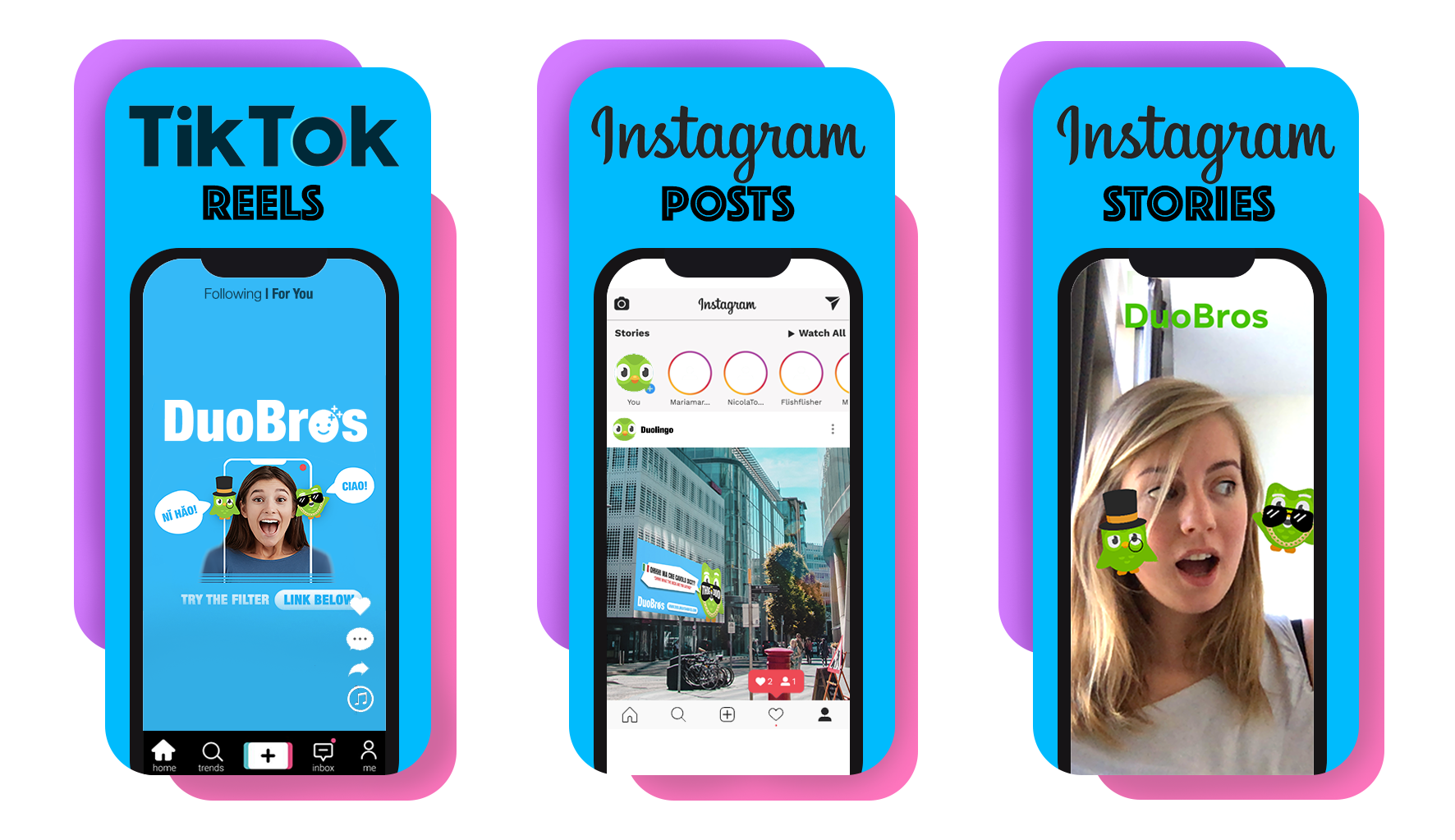

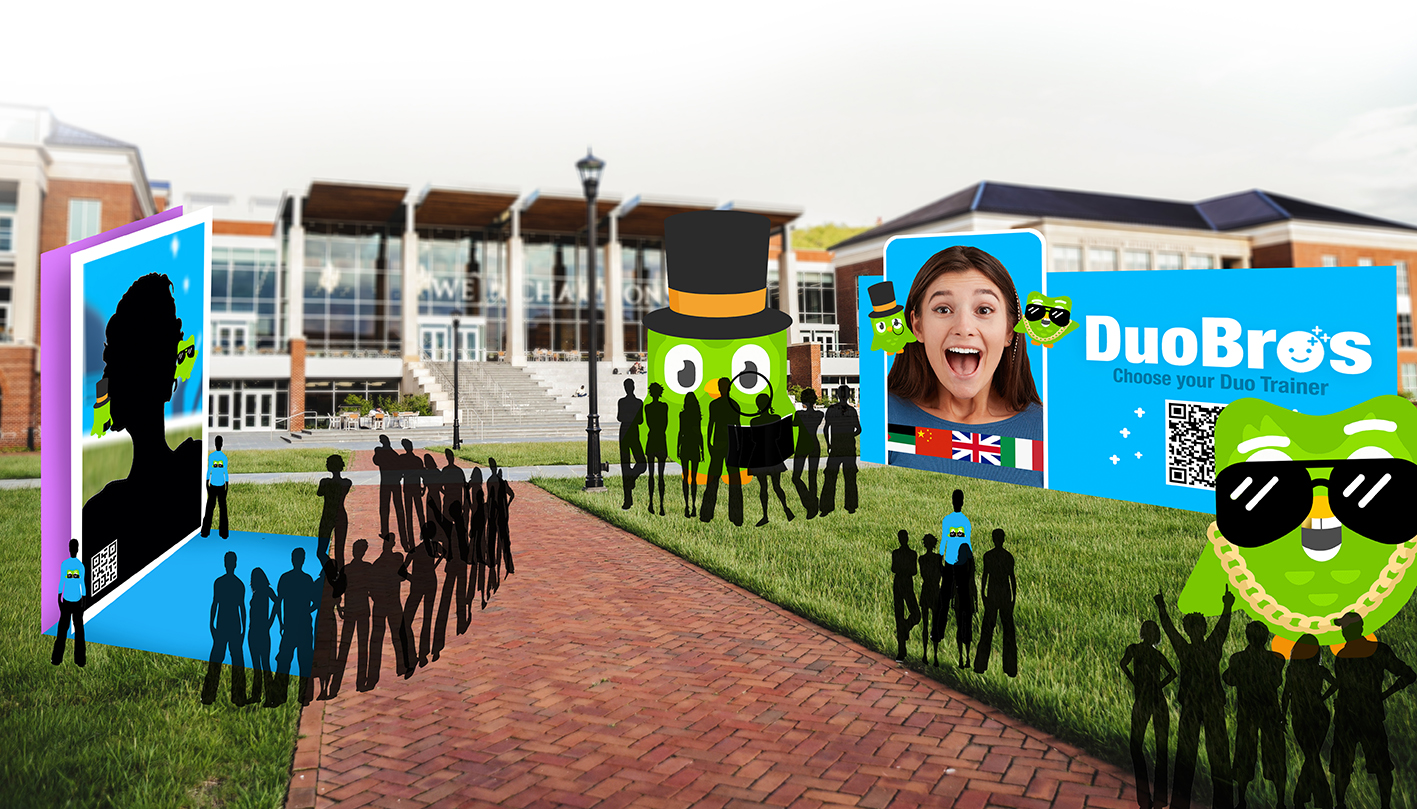

The Video
3 Filter Videos
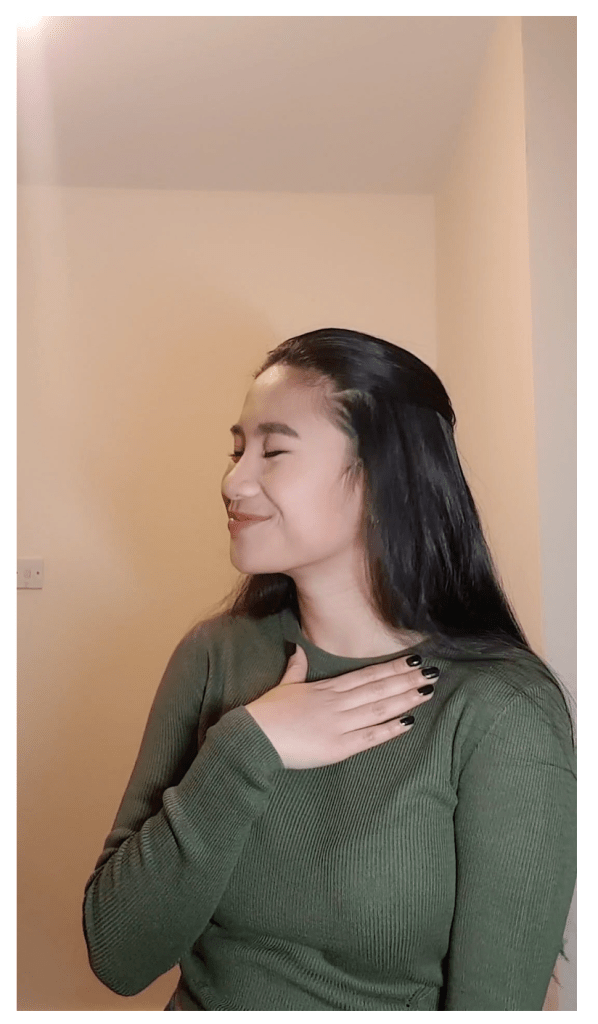
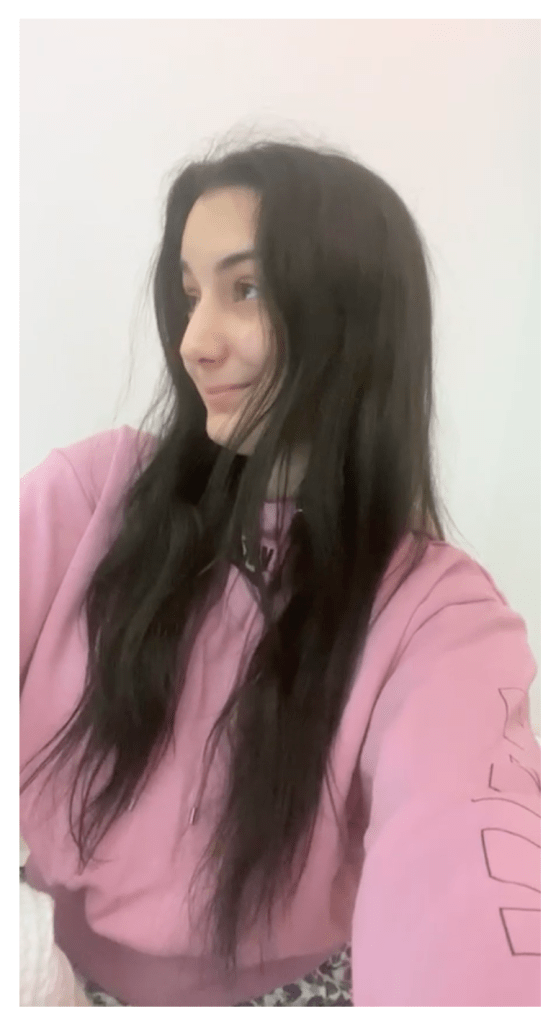
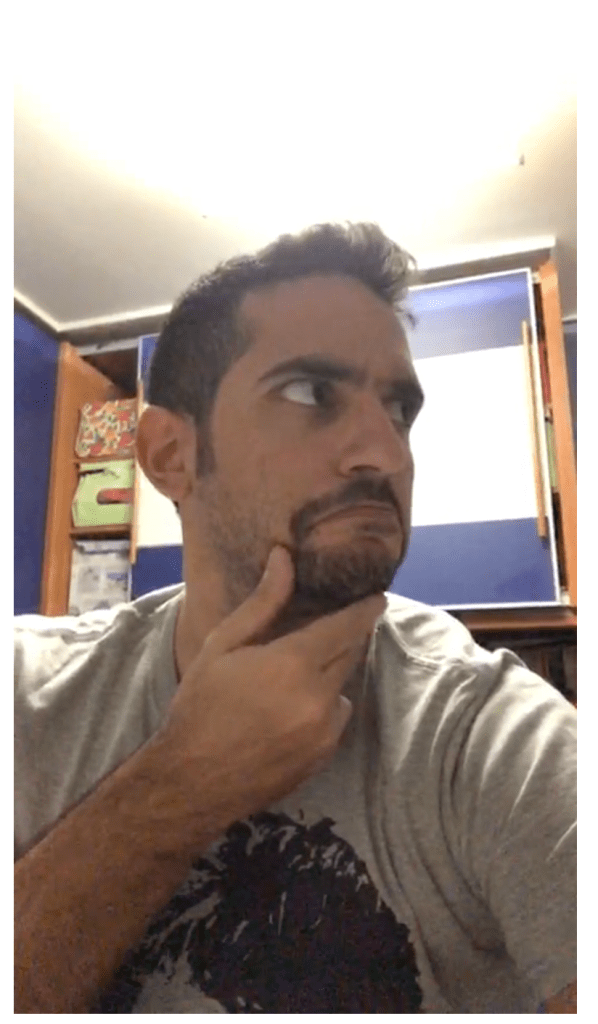
In the video, I asked 3 people to take a portrait video of themselves listening and interacting with ThugDuo and PoshDuo around them. I asked the three volunteers to act surprised and enthusiastic with ThugDuo and not be so interested in PoshDuo in order to show how the interaction with ThugDuo (the more confident character) is more entertaining. This will show the audience that interacting with someone who is freer/ not so cautious about grammar and sentence structures is far more entertaining than someone opposite.
Creating the Video
I created the video on After Effects and combined all the collected elements (videos, recordings and imagery). When considering the colour palette, I used the same colours as Duolingo use by taking them from the website design.duolingo.com.
The characters used were also taken from the same website and were adapted to fit the campaign. I edited the images on Photoshop and inserted them into AE. The fire symbol and speech bubble were taken from flaticon.com. The female character had blue trousers which bled into the background, so I used a Duolingo green instead (Hex: #8ee000).

The time-frame had to keep between 20 and 60 seconds. After editing the video, everything came to 52 seconds.
MUSIC
When choosing the music for the video, I chose ‘Most Happy Background Music For Videos’ which is an engaging upbeat tune which sits comfortable in the background. I wanted the audience to feel positive when watching the film and therefore the music needed to reflect this.
Rendering | AE and Adobe Media Coder
When exporting and publishing video, I encountered some difficulties rendering the video on AE, so I learnt a new way to export the file through Adobe Media Coder by following the video https://www.youtube.com/watch?v=mJwZ-nwvG3Q
The Final Video
Combining the main campaign insight with a moving narrative has been a rewarding and inspiring process. In the future I would like to work more with using videos to promote concepts. Using moving images in advertising is key especially for Gen Z’s as they need to engage with the project to gain interest. Creating the video on AE has been a useful challenge as I have discovered new ways of using the program and have learnt new problem solving skills in the process.
07.12.2020
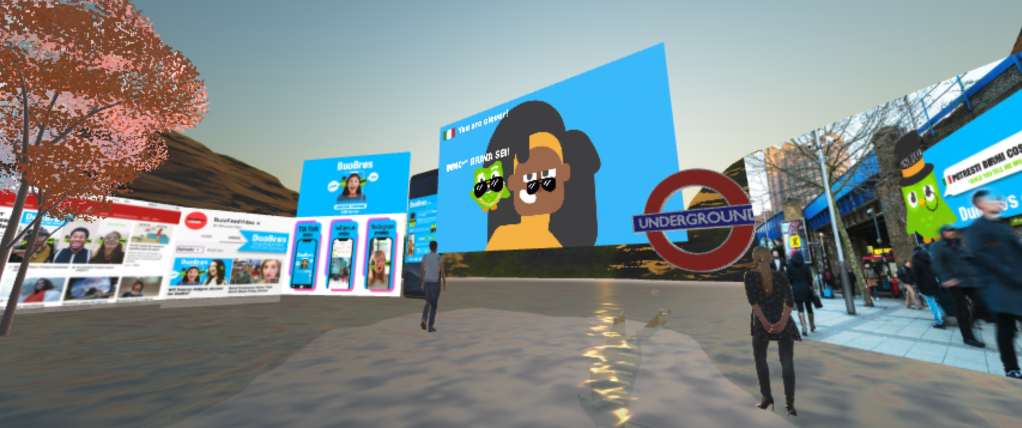
For the days leading up to the final hand-in I had been finalising and making adjustments to the project to make the insight clear, and the visual concepts affective within their environments. To present the work, I created a VR exhibit on Spoke, and exported it on Mozilla Hubs where I presented the project to the class.
The VR Exhibition
The visual content added to my exhibition room were arranged carefully in order to create an impacting project ‘reveal‘. My idea was that the audience would come through my exhibit and see final visuals in the distance so when they lead up to it, curiosity would heighten until the come out into the ‘open air’ and see the DuoBros campaign surrounding them.
Spoke hasn’t been the easiest program to use as there were many difficulties with inserting images and saving the project. Even when the files were compressed to a small file size, the images couldn’t be inserted in the project on many occasions, therefore a lot of patience and problem-solving was needed for this issue.
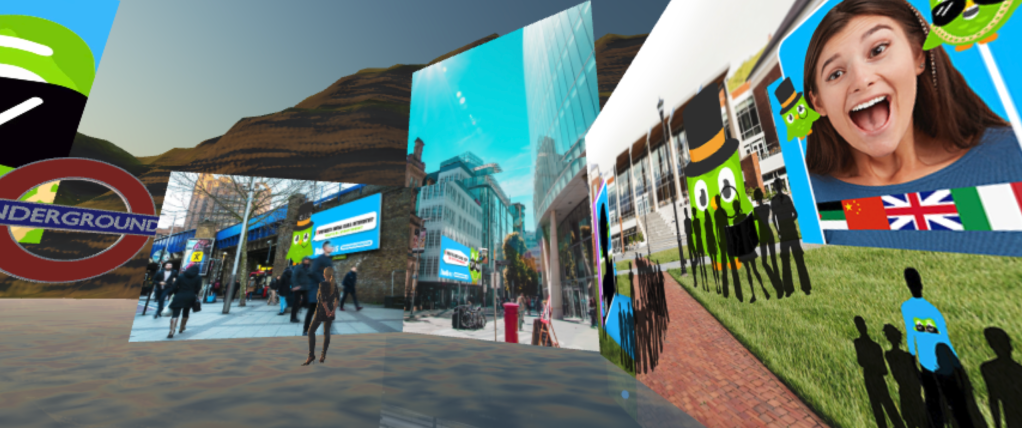
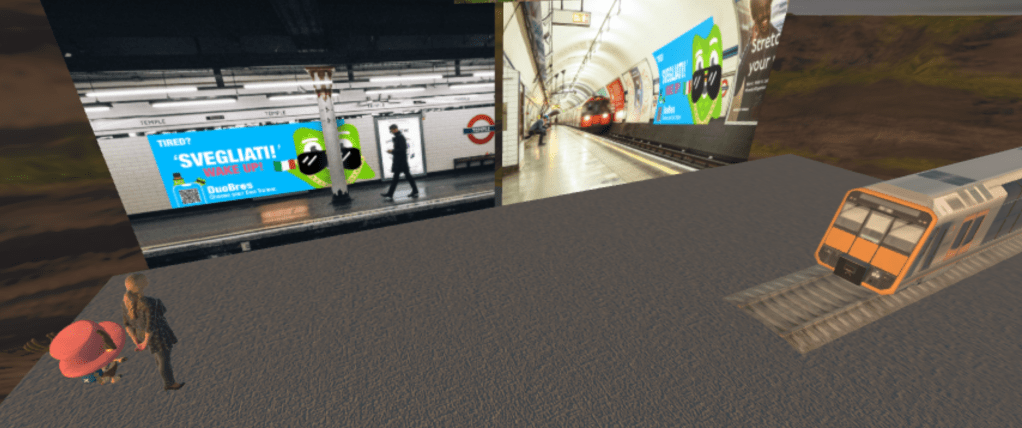
The final outcome of the exhibition is positive, and I am hoping the final presentation will run smoothly.
https://hubs.mozilla.com/CeCoQjt/duobros-presentation
Campaign Reflection
“She stood in the storm and when the wind did not blow her way, she adjusted her sails.”
Elizabeth Edwards
The Duolingo brief was created to encourage 16 – 22 year olds to use the Duolingo app and inspire them to learn new languages. The DuoBros campaign caters for this target demographic with an interactive language filter, bright colourful visuals across digital, video and physical media. Its engaging core insight, gaining confidence by fighting the fear of grammar, is relatable for Gen Zs and will build confidence and encourage language learning in their daily lives.
This multiplatform campaign will take place in major cities across the UK for one month, and has the potential of becoming a viral sensation. Once the DuoBros filter is released across social platforms TikTok and Instagram, it will reach Gen Zs worldwide through its popularity and addictive gamified approach.
The KPI’s of this campaign will be measured by the number of users reached and the increase of Duolingo application downloads across the campaign period (one month). The filter interactions can be accessed via Instagram and TikTok, and the number of downloads recorded from internal company records. Considering the campaigns viral potential, the comedic and interactive factor of the filter will spread organically through consumer engagement.
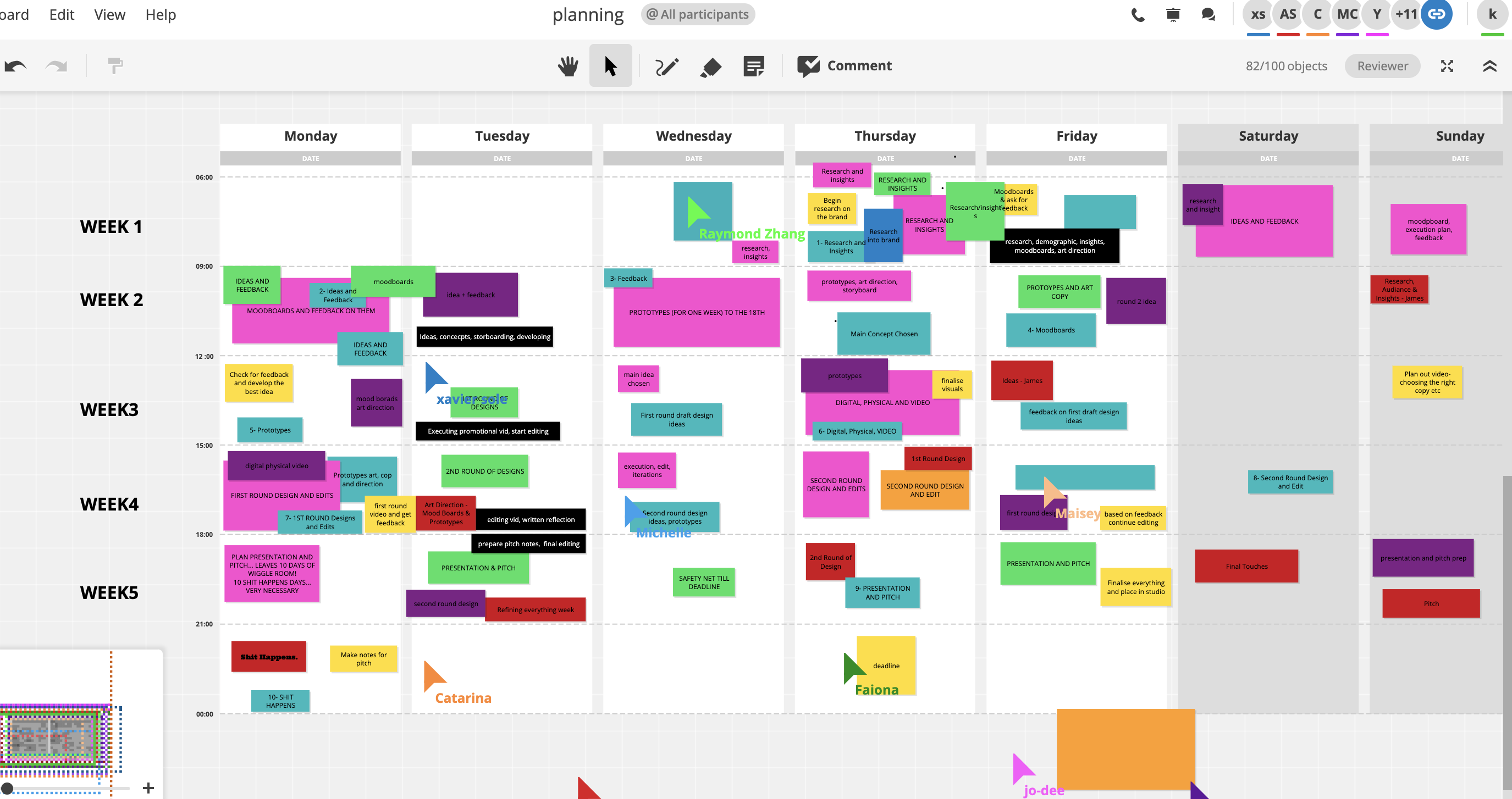
Following on from this campaign I intend to use the knowledge gained from this project and further develop my skills in future work. This brief has stretched my abilities as a creative and has revealed both strengths and weaknesses artistically and skills-wise. Working independently on this project meant having to set specific time-frames, plan and organise the tasks at hand, communicate with others, conduct research etc. Managing these tasks meant learning to prioritise certain actions over others and being flexible to program changes. At the beginning of the project I created a plan to follow over the weeks which helped when understanding the stage I should have reached at the time. The project timing didn’t end up so rigid and ended up spreading across more/ or less time than expected. For future projects, I will plan project timings in advance and be more flexible when adapting to unforeseen circumstances.
Photoshop has been a reliable program to use when creating digital visuals, however in this project I have experimented and discovered new programs to realise my ideas. Adobe After Effects and Media Coder were used for creating the DuoBros video, Spark AR to create the interactive filter, and Mozilla Hubs and Spoke to create the VR presentation. A program I have discovered and would like to use in future projects is Adobe XD. This program offers a wide range of tools which I would like to use to my advantage, like interactive artboards, prototypes, grids and smart canvas navigation (which can be used for creating websites/links).
Due to the COVID 19 pandemic, the DuoBros had to be created from home and that meant having limited resources and space. Distractions were the hardest challenge to deal with during this project as I was limited in choosing where to study and develop the campaign. Cafes and libraries have always been my go-to when needing to concentrate, so not having the choice of location meant having to purposefully adapt to my surroundings and finding peace/ concentration where I was. This practice was very useful as I have developed a gratitude for the freedom prior COVID, and a strength in dealing with unprecedented times.
The DuoBros campaign has been enjoyable to work on and I look forward to developing even more entertaining projects in the future.
 KatiesBlog