To begin the brief, we were told to complete a ‘Customer Research Report’ in pairs by analysing and researching the brief demographic and Duolingo as a brand. We were expected to complete this task in 4 weeks, and then to move onto the second part of the campaign.
To begin the process, we chose our partners (with the same brief) and started to think about arranging meetings, phone calls together. Considering my partner and I didn’t know each other very well to begin with, we briefly discussed our strengths and weaknesses as team players, and to arrange the distribution of the task between each other in a tactful way. Personally, I enjoy writing/ analysing and organising meetings/ calls etc, so I occupied myself with that, and my teammate on the other hand enjoys the artistic, art direction side of the project whilst also finding information and analysing it. As we both live in different cities, and we were in the middle of the COVID-19 pandemic, we decided to meet primarily over Microsoft teams and talk over the phone.
Our first meeting consisted of combining our individual research and ideas about the brief, and construct a plan of action between the two of us. The class had been told what was expected from the Customer Research Report, and were given guidelines as to how to structure it. This was a massive help, as I personally have never written a formal report before.
The Online Survey
Later on in the week, all of the Duolingo task members joined a Whatsapp group and decided to meet over Microsoft teams to discuss ideas and our thoughts on the brand. I organised and set up the group meeting over Teams and invited them, and managed to record the meeting to further analyse it later with my teammate. The group decided to create an online survey (with Google Forms) to gather data from a wider audience. We brainstormed questions together, and one member of the team put them together and published the survey.
The call was successful and very beneficial for all of the large group members. Hearing other peoples opinions about learning languages and Duolingo was very inspiring, and initiated ideas to start the report.
After the meeting, I volunteered to post an announcement on the universities Facebook page asking people to fill out the survey. The Facebook post received no follow up comments, therefore we all decided to send the survey to our friends and family directly (within the target demographic age range 16 – 22) which gained more interest. The personal touch of sending private messages seemed to be more effective.
Teamwork and Planning
Following on from this call, my teammate and I discussed how we should tackle the report as a pair, and decided to dedicate certain sections to each other as we were aware of time-keeping and deadlines. We discussed which parts worked to our strengths and also discussed possible answers and websites to explore. To make sure we were on track we arranged a meeting every other day in order to discuss our progress and help each other out with difficulties and dilemmas. Approaching the brief in this way was effective and worked to our advantage. We were both open to criticism and advice along the way, which helped with the dynamics of the project.
In order to gain further knowledge about our target audience, we arranged a Duolingo focus group. I personally occupied myself with creating a Whatsapp group and we both sent an announcement to our friends within the demographic to participate in the call.
My announcement was:
‘Hey everyone! Thank you for being willing to participate in Sunday’s Duolingo Focus Group! We really appreciate it and look forward to hearing your opinions!
The meeting will start at 14.00 and will begin asking questions at 14.05.
To prepare, here are the four main questions we will be asking:
What helps you decide to learn a language?
What motivates you to keep learning long term?
What is your ‘block’ when it comes to languages?
What’s the main factor you consider when deciding to download a language app?
This will take from 20 – 30 minutes, and will be a fun discussion so bring your ideas ready to share! 🙂 Will send the meeting link on Sunday! Thanks again‘
Before sending this message, as a pair we discussed what questions to ask and how we can use them in within our research. We thought it wise not to swamp the group with too many questions as we would prefer to hear their opinions in order to gather the data. Considering this, we were careful when deciding on the questions and filtered them down to a shortened list.
Focus group questions:
- Raise your hand if you have heard of duolingo
- Raise your hand if you are multilingual
- Those who have raised their hands, do you think it’s a good app?
- What helps you decide to learn a language?
- What motivates you to keep learning long term?
- What’s stopping you from learning a language/ continuing?
- What is your ‘block’ when it comes to languages?
- Have you ever felt embarrassed when speaking another language/ why?
- Raise your hand if you know Duolingo is free.
- What’s the main factor you consider when deciding to download a language app?
- Outside of language apps, what do you do to practise your language skills?
Optional Questions:
- At what point do you consider yourself to speak a language? eg asking for directions? Reading? Watching movies?
- Have you ever been embarrassed by having an accent?
- Do you have enough time to learn a language?
The questions in bold we considered to be the most important, and therefore used them in the focus group announcement (via Whatsapp) so that participants could prepare in advance and not feel flustered/ unable to answer the questions on the day. 12 of my connections were willing to participate and my teammate gained one person too, so we had a good turn out in the end.
The Focus Group Meeting
The participants of the Focus Group came different parts of the world (Canada, Philippines, England, South Africa, Italy, France, Germany, The Netherlands etc). This meant we were able to reach a wide range of Gen Z’s internationally, meaning the results weren’t bias.
Creating the Report
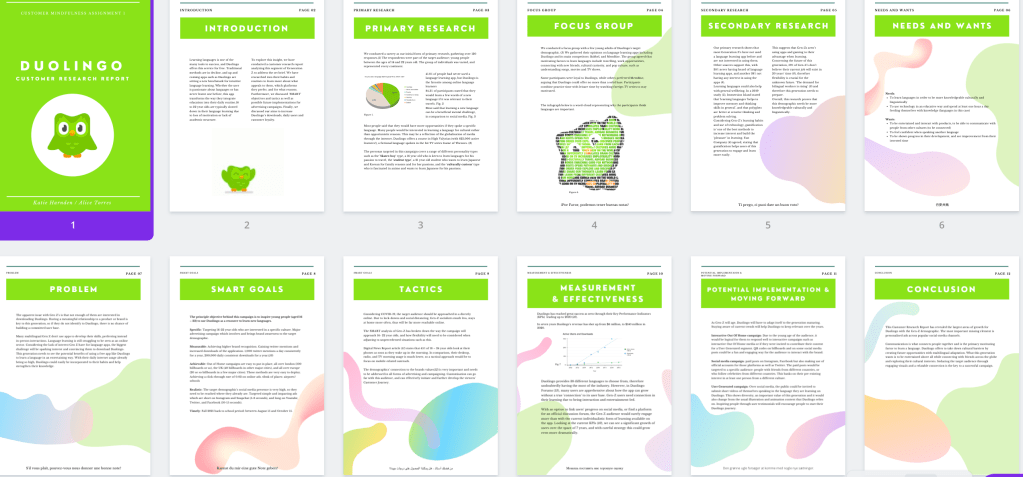
For the rest of the report, we divided the work load between us and combined all the gathered research while analysing and discussing the results. We held regular meetings (almost four/ five times a week) in order to understand each-others progress and help one another if needed. Once we finished the report, we edited and simplified the text in order to make the report digestible for the reader. We used Canva to make the report creative and aesthetically pleasing, and worked collaboratively on finalising the work in a professional and effective manner.
Report Work Division Summary
Peer Review
- Focus group – invited friends, created recorded teams room
- Carried out individual research
- Brainstormed questions survey/ focus group
- Wrote sections – Introduction (200 words), Research Section 1(350 words), – Potential Implementation / Moving Forward 250 words), SMART (200 words)
- Thought of ideas for Personas
- Finalized all written work together
- Created ‘Customer Profiles’ together
- Customized the report on Canva together
Self Review
- Organised meetings/ focus group
- Focus group – invited friends, set up WhatsApp chat
- Researched initial ideas (finding links and references for report)
- Carried out individual research
- Brainstormed questions survey/ focus group
- Created Personas and thought of ideas
- Created Duo Infograph
- Wrote sections – Introduction (200 words), Research Section 2 with research references (350 words), Insight/ problem (209 words), Tactics (200 words), Measurement & Effectiveness (250 words)
- Finalized all written work together
- Customized the report on Canva together
- Created ‘Customer Profiles’ together
The report has been a fun and challenging project to work on, and I have thoroughly enjoyed working collaboratively with my partner. We played to each others strengths throughout the project which eventually paid off with the results we have achieved. This is the first report I have made, and have thoroughly enjoyed the process of collecting data, analysing and presenting it.
 KatiesBlog